Quick answer
A cake is done when the middle springs back leaving no dent, a skewer comes out with moist crumbs rather than wet batter, the edges have pulled slightly from the pan wall, and the surface has stopped hissing. A clock is a starting point, not a verdict, since home ovens commonly run 25 F from their dial.

Ateco 1445 Cake Tester
A thin wire leaves a hole you cannot see, unlike a skewer, which matters on the top of a cake you are about to glaze rather than frost.
Best for: testing doneness without marking the top
Check price on AmazonA bake time chart can only ever give a computed starting point, because it has no way to know how your particular oven actually behaves. The number that decides whether a cake is done has to come from the cake itself, not the clock on the wall. There are four signs worth checking, together rather than any one alone, and none of them require an internal temperature reading, which is a figure this site will not hand you as a tested number because nobody baked these cakes with a probe in hand.
The reason the clock cannot be trusted on its own is not a small one. A home oven that reads 350 F on its dial routinely runs 25 F out in either direction once it is actually holding temperature, and that swing moves a real bake time further than the width of any printed range. The bake time calculator and the bake time chart both give a computed range to start checking at, and this page covers what to do once you get there.
What are the four signs a cake is actually done?
These four checks work together. A cake that passes one but fails another is usually a few minutes short, not finished.
- The middle springs back. Press the centre lightly with a fingertip. If it springs back fully and leaves no dent, the structure has set. If your finger leaves a mark, the crumb has not finished firming up.
- A skewer comes out with moist crumbs, not wet batter. A few soft crumbs clinging to the skewer is exactly what you want. Wet, shiny batter on the skewer means it needs more time; a skewer that comes out bone dry with no crumbs at all usually means the cake has gone past done and is drying out.
- The edges have pulled slightly from the pan wall. Look for a thin gap, a couple of millimetres, between the cake and the metal all the way round. This happens as the cake firms up and shrinks back very slightly, and it rarely shows up before the cake is close to ready.
- The surface has stopped hissing. Listen, not just look. That faint hiss is the sound of water still boiling off the surface as steam. Once it goes quiet, most of the surface moisture has cooked away.
How do I test cake doneness step by step?
Do this at the start of the checking window your bake time chart or calculator gives you, then again every few minutes until the cake passes.
- Open the oven door as briefly as possible and look at the surface first. If it still looks wet and glossy, close the door and give it more time before testing anything else.
- Press the centre of the cake lightly with a clean fingertip. It should spring back fully with no dent left behind.
- Insert a thin skewer or cake tester into the exact centre of the cake, which is the last part to finish, and pull it straight out.
- Check the skewer for moist crumbs. Wet batter means back in the oven; a few soft crumbs is the target; a dry, crumbless skewer means it may already be a little overbaked.
- Look at the edges for a slight gap from the pan wall, and listen for whether the surface has gone quiet.
- If two or more of the four signs have not shown up yet, close the door and check again in three to five minutes rather than leaving it in continuously, since repeated door-opening drops oven temperature and slows the bake.
- Once the cake passes at least three of the four checks, pull it and let it cool in the pan for ten minutes before turning it out, since a cake is still finishing its structure in that first cooling stretch.
Why can't a timer alone tell me when a cake is done?
Because the timer only knows the number on a chart, and that number is a computed estimate from the pan's geometry, not a measurement of your oven. The table below shows the same 8 inch round pan at three oven temperatures, all run through the site's bake time formula.
| Oven temperature (F) | Start checking (min) | Expected range (min) |
|---|---|---|
| 325 | 30 | 30 to 45 |
| 350 | 25 | 25 to 40 |
| 375 | 20 | 20 to 30 |
What if the skewer looks clean but the cake sinks after cooling?
This is one of the most common complaints, and it almost always traces back to one of a short list of causes rather than a mystery.
| What happened | Likely cause | What to check next time |
|---|---|---|
| Skewer was clean, but the middle sank while cooling | Tested too close to the edge instead of the exact centre, which finishes last | Test the true centre of the cake, not partway between the middle and the wall |
| Cake looked done, then collapsed after being moved | Turned out of the pan before the structure finished setting during cooling | Cool in the pan for about ten minutes before turning out |
| Top looks done, but a dense wet streak runs through the middle | Underbaked despite a clean-looking skewer, common in a very deep or dense batter | Test with a longer skewer, at least as long as the cake is deep, and add more time |
| Cake domed high, then sank hard in the centre once cool | Oven ran hot, setting the edges long before the middle caught up | Try the same bake 25 F lower, and see the doming guide for bake-even strips |
| Cake sank right in the middle as soon as it came out | Door opened too often during baking, or pulled before the middle finished | Limit checks to every three to five minutes and confirm at least three of the four doneness signs |
What this job actually needs
Ateco 1445 Cake Tester
$3.95A thin wire leaves a hole you cannot see, unlike a skewer, which matters on the top of a cake you are about to glaze rather than frost.
Best for: testing doneness without marking the top
Check price on AmazonAmazon prices move often, so check before you buy.
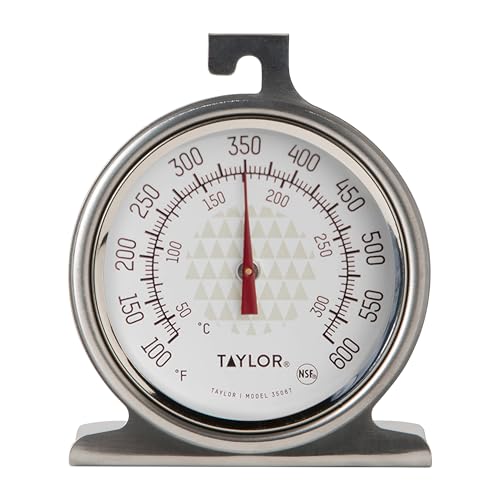
Taylor Large 2.5 Inch Dial Oven Thermometer
$8.28Home ovens routinely run 25 F or more off their dial, which is the real reason a bake time chart never matches your oven, and this is the cheapest way to find out by how much.
Best for: finding out what your oven actually does
Check price on AmazonAmazon prices move often, so check before you buy.
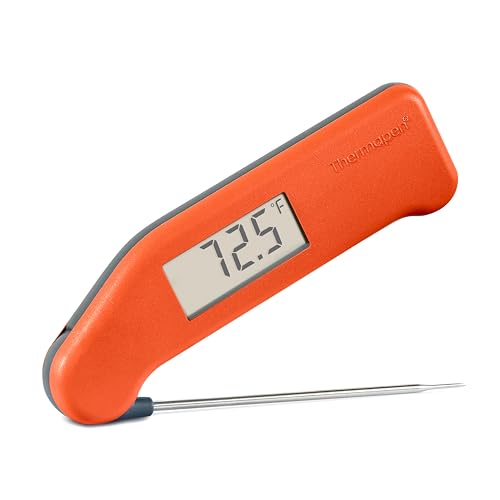
ThermoWorks Classic Thermapen Instant-Read Thermometer
$105.00The older Thermapen at a lower price, slower to read than the ONE but with the same probe accuracy, which is the part that matters for tempering.
Best for: accurate readings without the flagship price
Check price on AmazonAmazon prices move often, so check before you buy.
Questions people ask
- How do I know a cake is done without a thermometer?
- Check four things together: the middle should spring back with no dent when pressed lightly, a skewer inserted into the centre should come out with a few moist crumbs rather than wet batter, the edges should have pulled slightly away from the pan wall, and the surface should have stopped hissing. None of these need a thermometer, and a cake that passes most of them is reliably done.
- Why did my skewer come out clean but the cake was still raw in the middle?
- The skewer probably went in near the edge or partway to the centre rather than into the exact middle of the cake, which is the part that finishes cooking last. A short skewer can also simply not reach the bottom of a deep pan. Use a skewer at least as long as the pan is deep and aim for dead centre, then check again.
- Can I just trust the timer on a bake time chart?
- Not on its own. A bake time chart gives a computed starting point from the pan's size and depth, not a measurement of your particular oven, and home ovens commonly run about 25 F away from their dial setting. Use the chart's low end as when to start checking, then let the springback, skewer, edge and sound tests decide when it actually comes out.
- Why does the middle of my cake sink after baking?
- Usually one of three things: it was pulled before the centre finished setting, it was turned out of the pan too soon while still structurally soft, or the oven ran hot enough that the edges set long before the middle did. Testing the true centre with a long skewer and cooling in the pan for about ten minutes before turning out fixes most cases.
- Does the toothpick test work for a dense or fudgy cake?
- It works, but the target changes. A dense or deliberately fudgy cake, closer to a brownie in texture, is meant to show a few moist crumbs and a slightly tacky skewer rather than a completely dry one. Pulling it to a bone dry skewer, the standard for a light sponge, will usually overbake a dense batter.
Related pages
How this page was put together
Researched from pan geometry, published manufacturer capacities, published serving conventions and university extension guidance. Not hands-on testing, and not professional advice.
Figures are labelled as derived, published or trade convention. Where no honest figure exists, the page says so rather than filling the gap.