Quick answer
An 8 inch round pan filled two thirds starts checking at 25 minutes and usually runs 25 to 40 minutes at 350 F. A 10 inch round pan runs 35 to 55 minutes at 325 F, since a 10 inch span or wider bakes at the lower temperature. These are computed estimates, not tested times.
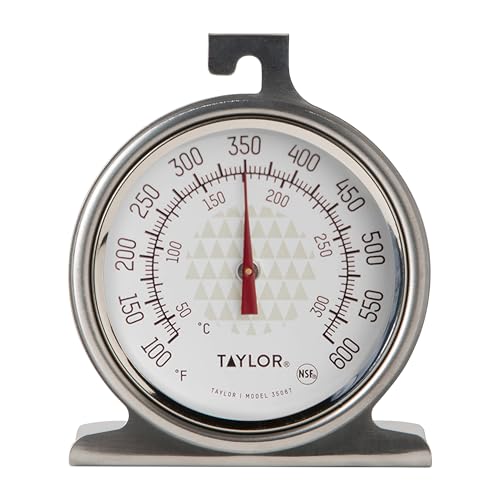
Taylor Large 2.5 Inch Dial Oven Thermometer
Home ovens routinely run 25 F or more off their dial, which is the real reason a bake time chart never matches your oven, and this is the cheapest way to find out by how much.
Best for: finding out what your oven actually does
Check price on AmazonEvery bake time on this page is a computed starting point, not a measured one. Nobody baked these cakes with a stopwatch. The figures come from a formula built on the pan's batter depth, floor area and oven temperature, shown in full further down this page, and they exist to give you a moment to start checking rather than a moment to pull the cake regardless. An 8 inch round pan filled two thirds comes out to roughly 25 to 40 minutes at 350 F. A 10 inch round pan runs 35 to 55 minutes at 325 F, and it drops to the lower temperature because past a 10 inch span the outside of a cake sets well before the middle does at 350 F.
Batter depth, not diameter, is what actually drives this: heat travels in from the wall and up from the floor, so a deep, narrow pan and a shallow, wide one at the same depth bake in similar time even though their diameters differ hugely. Scale any pan and fill level in the bake time calculator, and check the batter depth behind each figure on the batter volume chart.
How long does an 8 inch cake take to bake?
The common round layer pan depth is 2 inches, which puts the batter about 1.33 inches deep at a two thirds fill. The table below runs every common round size at that depth, and the widening range from a 6 inch pan up to a 14 inch pan traces almost entirely to floor area rather than any change in batter depth.
| Pan | Batter depth (in) | Oven temp (F) | Start checking (min) | Expected range (min) |
|---|---|---|---|---|
| 6 in round | 1.33 | 350 | 20 | 20 to 30 |
| 8 in round | 1.33 | 350 | 25 | 25 to 40 |
| 9 in round | 1.33 | 350 | 30 | 30 to 45 |
| 10 in round | 1.33 | 325 | 35 | 35 to 55 |
| 12 in round | 1.33 | 325 | 45 | 45 to 65 |
| 14 in round | 1.33 | 325 | 50 | 50 to 75 |
Does a 3 inch tall pan take much longer than a 2 inch pan?
Yes, substantially, because a 3 inch pan filled two thirds carries a full inch more batter depth, and depth is the strongest driver in the model. A tall tier pan always runs at 325 F regardless of its diameter.
| Pan | Batter depth (in) | Oven temp (F) | Start checking (min) | Expected range (min) |
|---|---|---|---|---|
| 6 in round, 3 in deep | 2.00 | 325 | 40 | 40 to 60 |
| 8 in round, 3 in deep | 2.00 | 325 | 50 | 50 to 75 |
| 9 in round, 3 in deep | 2.00 | 325 | 55 | 55 to 85 |
| 10 in round, 3 in deep | 2.00 | 325 | 65 | 65 to 95 |
| 12 in round, 3 in deep | 2.00 | 325 | 75 | 75 to 110 |
How long does a sheet cake or square pan take?
Sheet pans bake fastest of anything on this chart, because their shallow 1 inch depth cuts batter depth roughly in half compared with a layer pan.
| Pan | Batter depth (in) | Oven temp (F) | Start checking (min) | Expected range (min) |
|---|---|---|---|---|
| 6 x 6 in square | 1.33 | 350 | 25 | 25 to 35 |
| 8 x 8 in square | 1.33 | 350 | 30 | 30 to 45 |
| 9 x 9 in square | 1.33 | 350 | 35 | 35 to 50 |
| 10 x 10 in square | 1.33 | 325 | 40 | 40 to 60 |
| 12 x 12 in square | 1.33 | 325 | 50 | 50 to 70 |
| 9 x 13 in rectangle | 1.33 | 350 | 40 | 40 to 60 |
| Quarter sheet, 9 x 13 in | 0.67 | 350 | 15 | 15 to 25 |
| Half sheet, 13 x 18 in | 0.67 | 325 | 25 | 25 to 35 |
| 12 x 18 in rectangle | 1.33 | 325 | 60 | 60 to 85 |
| Full sheet, 18 x 26 in | 0.67 | 325 | 35 | 35 to 50 |
What does the oven temperature actually do to bake time?
Temperature enters the model as roughly its inverse three-halves power, which is a smaller effect than batter depth but still a real trade-off between speed and how flat the top comes out. Dropping the oven by 25 F on a pan you are worried about doming is a safe, reversible experiment, since the worst outcome is a cake that takes a little longer than expected rather than one that fails outright.
minutes = 3.79 × (batter depth in inches)1.3 × (floor area in sq in)0.45 × (350 / oven temperature F)1.5
That is the whole formula behind every figure on this page, run on an 8 inch round pan below at four temperatures. The band is wide on purpose: a home oven that reads 350 F on its dial routinely runs 25 F out in either direction, which moves the real bake time further than the width of any of these ranges.
| Oven temperature (F) | Estimated range (min) | Trade-off |
|---|---|---|
| 300 | 35 to 50 | Flattest top, palest crust, longest bake |
| 325 | 30 to 45 | The usual choice for large or deep pans |
| 350 | 25 to 40 | The default for layer pans under a 10 inch span |
| 375 | 25 to 35 | Faster, more doming, a noticeably darker edge |
What this job actually needs
Taylor Large 2.5 Inch Dial Oven Thermometer
$8.28Home ovens routinely run 25 F or more off their dial, which is the real reason a bake time chart never matches your oven, and this is the cheapest way to find out by how much.
Best for: finding out what your oven actually does
Check price on AmazonAmazon prices move often, so check before you buy.
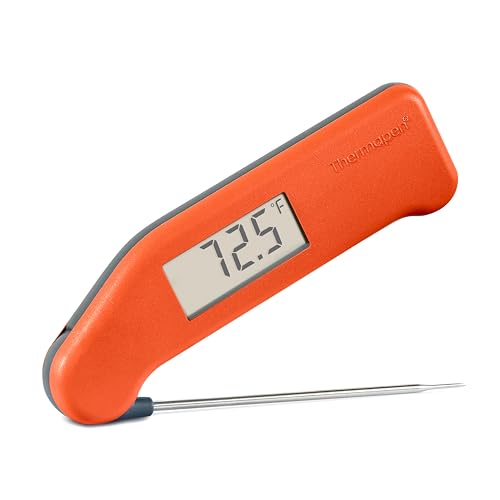
ThermoWorks Classic Thermapen Instant-Read Thermometer
$105.00The older Thermapen at a lower price, slower to read than the ONE but with the same probe accuracy, which is the part that matters for tempering.
Best for: accurate readings without the flagship price
Check price on AmazonAmazon prices move often, so check before you buy.

Wilton Bake-Even Cake Strips, 2 Piece Set
$10.99Damp strips around the pan slow the outside so the middle catches up, which is what stops a dome forming and saves you levelling off the top and throwing it away.
Best for: flat layers with no trimming
Check price on AmazonAmazon prices move often, so check before you buy.
Questions people ask
- How long does it take to bake an 8 inch round cake?
- Start checking at 25 minutes and expect a total bake of 25 to 40 minutes at 350 F, for a pan filled two thirds with the batter sitting about 1.33 inches deep. This is a computed starting point from the pan geometry, not a tested figure, and the doneness test, a springy middle and a skewer with moist crumbs, decides the actual moment it comes out.
- Why do bigger cake pans bake at a lower temperature?
- Once the shortest span across a pan reaches about 10 inches, or the pan is 3 inches deep, the outside of the cake sets long before the middle does if the oven stays at 350 F. Dropping to 325 F slows the outside down so the centre has time to catch up, which is why a 10 inch round pan and a 3 inch deep tier pan both bake at the lower temperature on this chart regardless of their exact size.
- Why is the bake time given as a range instead of one number?
- Because a single number would be false precision. The figure is computed from pan geometry rather than measured with a stopwatch, and home ovens commonly run 25 F away from their dial setting in either direction, which shifts the real bake time by more than the width of the printed range. Treat the low end as when to start checking and let the doneness test decide the rest.
- Does batter depth or pan diameter matter more for bake time?
- Batter depth matters far more. Heat travels in from the pan wall and up from the floor, so a deep, narrow pan and a shallow, wide pan at the same batter depth bake in roughly similar time even though their diameters are very different. This is also why filling a pan higher always adds noticeably more time than making the cake a little wider does.
- Do bake-even strips change the bake time?
- Yes, usually adding a few minutes, and it is a worthwhile trade. A damp strip wrapped around the pan slows the outside enough for the middle to catch up, which is what stops a dome from forming in the first place. The cake finishes flatter, which saves the layer you would otherwise have levelled off and thrown away.
Related pages
How this page was put together
Researched from pan geometry, published manufacturer capacities, published serving conventions and university extension guidance. Not hands-on testing, and not professional advice.
Figures are labelled as derived, published or trade convention. Where no honest figure exists, the page says so rather than filling the gap.