Quick answer
The best single tool for smooth buttercream sides is the Ateco Stainless Handle Bench Scraper, 5.9 x 3 in at $9.99, a straight stainless edge held against a turning cake. Fondant work needs a dedicated flat smoother instead, and a textured finish needs a decorating comb, which is a different tool for a different result.

Ateco Stainless Handle Bench Scraper, 5.9 x 3 in
A straight, stiff stainless edge held vertical against a turning cake is how a sharp buttercream side is actually made, and it does more for the finish than any other single tool on this page.
Best for: sharp-edged buttercream
Check price on AmazonThe single tool that does the most for a frosted cake is the Ateco Stainless Handle Bench Scraper, 5.9 x 3 in at $9.99. Held still and vertical while the cake turns underneath it on a turntable, a straight stiff edge cuts a sharper, flatter side than a curved comb or a spatula ever will, and it costs under ten dollars.
Beyond that one tool, this category splits by finish rather than by skill level: a comb gives texture, a plain smoother gives a flat fondant surface, and a leveler cuts the top of a layer flat before any of it starts. Pick the tool for the finish you are chasing rather than assuming one does all three jobs.
None of this works without something steady to turn the cake on: see the best offset spatulas for the tool that spreads the frosting these smoothers finish.
What smoothing tools does a first cake need?
A flat top and a straight side are the two things that make a home-decorated cake look intentional, and both come from tools under ten dollars each.
Ateco Stainless Handle Bench Scraper, 5.9 x 3 in
$9.99A straight stiff edge held vertical against a turning cake is how a sharp buttercream side is made, and it beats a curved comb for this specific job.
Best for: sharp-edged buttercream
Check price on AmazonAmazon prices move often, so check before you buy.

Wilton Adjustable Cake Leveler, 12 x 6.25 in
$19.49A wire on an adjustable frame cuts a flatter torte than a knife does, because the wire follows the height you set rather than the angle of your wrist.
Best for: torting layers evenly
Check price on AmazonAmazon prices move often, so check before you buy.
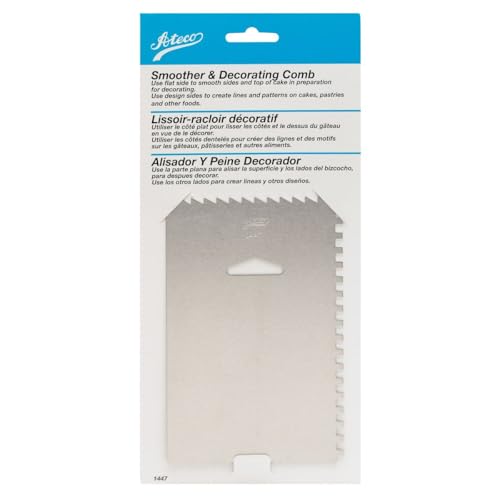
Ateco 4 Sided Decorating Comb and Icing Smoother, 6 x 3.75 in
$6.63Four profiles on one piece of metal, so a single cheap tool gives a plain smooth side, a fine rib, a coarse rib and a wave.
Best for: textured buttercream sides
Check price on AmazonAmazon prices move often, so check before you buy.
What upgrade actually improves a finish?
Fondant needs its own smoother rather than a buttercream tool, and a taller tier benefits from a taller comb face that covers the side in fewer passes.

Ateco 1301 Fondant and Icing Smoother
$7.94The fondant smoother from a trade supplier rather than an unbranded two pack, with a flat face and a square corner for pressing the bottom edge in cleanly.
Best for: finishing a fondant covering
Check price on AmazonAmazon prices move often, so check before you buy.
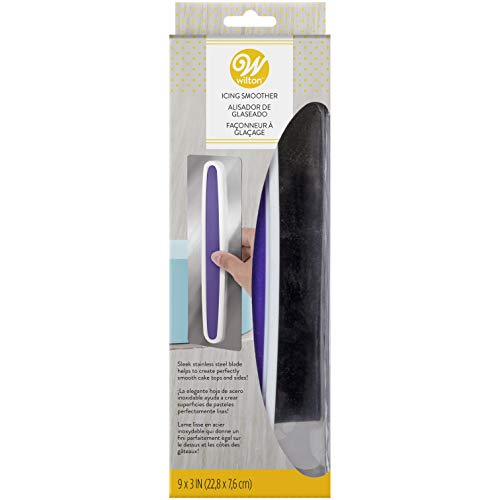
Wilton 3 Piece Icing Comb Set
$18.06Three separate combs rather than three edges on one tool, which means a taller working face and fewer passes up the side of a deep tier.
Best for: tall tiers where a short comb needs two passes
Check price on AmazonAmazon prices move often, so check before you buy.
What does a complete leveling and smoothing setup look like?
At the top of this category the two jobs, cutting a flat top and truing a straight side, get paired into one purchase, which matters most on a cake that has to look genuinely square before decorating starts.
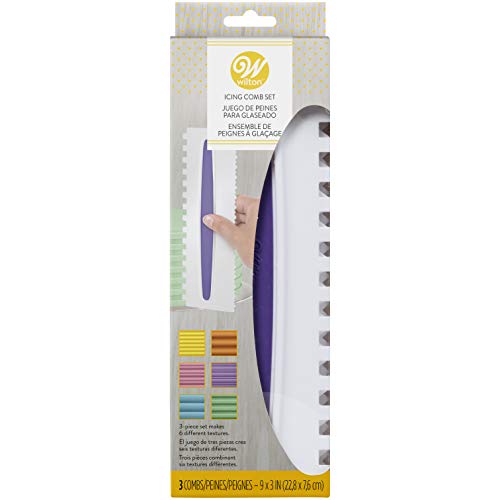
Wilton Cake Icing Smoother and Adjustable Cake Leveler Set
$37.55Pairs the two tools that decide whether a cake looks straight: a leveler that cuts a flat top and a smoother tall enough to true the side against it.
Best for: getting a cake genuinely square before decorating
Check price on AmazonAmazon prices move often, so check before you buy.
Who should not buy this
This combined set is not for someone decorating an occasional cake with a single finish in mind. A separate bench scraper and cake leveler bought individually cost less than the combined kit and cover the same two jobs; the paired set earns its price mainly for someone regularly building tall, precisely square tiers.
How do these smoothers and combs compare?
| Tool | Use | Material | Price |
|---|---|---|---|
| Ateco Bench Scraper | Straight buttercream sides | Stainless steel | $9.99 |
| Ateco 4 Sided Decorating Comb | Four textured finishes | Metal | $6.63 |
| Ateco 1301 Fondant Smoother | Flat fondant coverings | Plastic | $7.94 |
| Wilton 3 Piece Icing Comb Set | Tall-tier textured finishes | Plastic | $18.06 |
| Wilton Smoother and Leveler Set | Leveling and smoothing together | Plastic and wire | $37.55 |
How we chose
Researched from published manufacturer specifications, stated materials and dimensions, and the consensus of verified owner reviews. Nothing here was tested in person, and nothing here is professional advice. A smoother or comb is judged here on stated material and edge profile, since a flexible comb face flexes against a curved side without digging in, while a rigid bench scraper edge is what actually cuts a straight line. Cake decorating stencils appear only as a scoped search elsewhere on this site, because every listing found in that category was unbranded, unlike the smoothers and combs here, which are available from named makers.
Buying tips
A bench scraper and a decorating comb are not interchangeable even though both press against the side of a turning cake. A scraper gives a plain flat side; a comb cuts a repeating texture into it. Buy the scraper first, since a flat side is the base every other finish sits on top of.
Buttercream and fondant want different smoothers. A fondant smoother is a rigid flat plastic paddle meant to press air out and true a covering, while buttercream is smoothed with a flexible scraper or comb held against it while the cake turns. Using a fondant smoother on buttercream tends to drag and tear the surface.
A turntable underneath any of these tools matters as much as the tool itself, because a smooth side comes from the cake turning at a steady speed while the scraper holds still, not from the scraper moving around a stationary cake.
A few things worth knowing before any of this reaches a plate. Cream cheese frosting and anything made with whipped cream needs to stay refrigerated, and plain buttercream softens in a warm room well before it is unsafe, which is a structural problem rather than a health one. Royal icing made with raw egg white is worth swapping for pasteurised egg white or meringue powder when you are decorating for children, older guests or anyone pregnant. If you are decorating a cake for someone else, ask about allergies before you start, since cross contact happens at the piping bag as easily as at the mixing bowl. And if cakes are something you sell rather than give away, that is governed by your state cottage food law, which varies a great deal from state to state.
What this job actually needs

Ateco Revolving Cake Decorating Stand, Aluminum Turntable with Cast Iron Base
$68.26The cast iron base is the whole point: a heavy turntable keeps spinning at a steady speed while you hold a scraper still, which is what produces a smooth side.
Best for: smooth buttercream sides
Check price on AmazonAmazon prices move often, so check before you buy.

Fat Daddio's Stainless Steel Offset Spatula, 12 in
$14.99A 12 inch blade for full sheet cakes, where anything shorter means joining passes and every join shows.
Best for: sheet cakes and very large tops
Check price on AmazonAmazon prices move often, so check before you buy.

Wilton Bake-Even Cake Strips, 2 Piece Set
$10.99Damp strips around the pan slow the outside so the middle catches up, which is what stops a dome forming and saves you levelling off the top and throwing it away.
Best for: flat layers with no trimming
Check price on AmazonAmazon prices move often, so check before you buy.
Questions people ask
- What is the difference between a bench scraper and a decorating comb?
- A bench scraper has a single plain straight edge and produces a smooth, flat side with no texture. A decorating comb has one or more toothed or ribbed edges that cut a repeating pattern into the frosting as it passes. Both are held still against a turning cake, but they are chosen for opposite results: plain and smooth, or textured and patterned.
- Can I use the same smoother for buttercream and fondant?
- Not well. A fondant smoother is a rigid flat paddle designed to press air bubbles out of a firm covering, while buttercream wants a flexible scraper or comb held against a turning cake to true the side. Using a fondant smoother on buttercream tends to drag and tear the surface rather than smoothing it, so it is worth owning one of each if you work in both.
- Do I need a cake leveler if I already have a serrated knife?
- A knife will torte a cake, but a leveler with an adjustable wire cuts a flatter layer because the wire follows a set height rather than your wrist, which tends to wander over a wide cake. If layers coming out uneven is a recurring problem, a leveler solves it more reliably than practicing with a knife does, and it costs under twenty dollars.
- Why does my buttercream side never come out flat?
- Almost always this is technique rather than tools: the scraper needs to stay still and vertical while the cake turns beneath it on a turntable, rather than being dragged around a stationary cake by hand. A wobbly or lightweight turntable makes this harder, since any rock in the platform shows up as a wave in the finished side.
- What thickness should a fondant smoother be?
- A rigid, fairly thick paddle works better than a thin flexible one, because the point of a fondant smoother is to press evenly and true the surface, and a thin paddle flexes under pressure rather than staying flat. Look for a stated flat face and a squared corner in the product description, since the corner is what presses the bottom edge of a fondant covering in cleanly.
Related pages
How this page was put together
Researched from published manufacturer specifications, stated materials and dimensions, and the consensus of verified owner reviews. Nothing here was tested in person, and nothing here is professional advice.
Figures are labelled as derived, published or trade convention. Where no honest figure exists, the page says so rather than filling the gap.