Quick answer
The Escali Primo Digital Food Scale, about $25.00, is the pick for baking: it reads fast, tares instantly, and does not try to double as a nutrition tracker. A budget scale still beats no scale at all, and a scale with 0.1 gram resolution matters once you are weighing baking powder or salt.
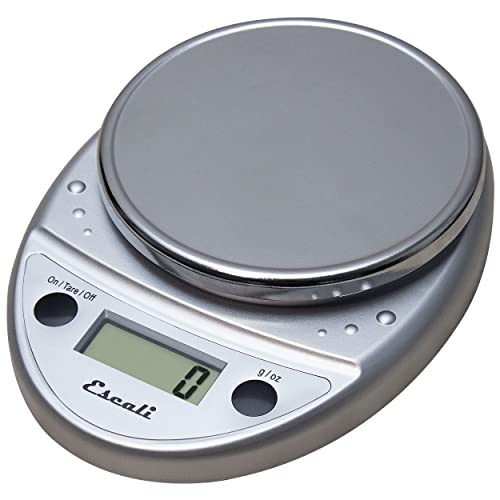
Escali Primo Digital Food Scale
It is the scale most often found on a professional bench because it reads fast, tares instantly, and does nothing else, which is exactly what weighing cake ingredients needs.
Best for: weighing every ingredient, which is what makes scaling a recipe work
Check price on AmazonFor weighing cake ingredients, the Escali Primo Digital Food Scale at $25.00 is the pick. It tares instantly, reads fast, and is not trying to be a nutrition tracker or a smart-home gadget, which is the whole job a baking scale has to do.
Owning any scale at all is the single biggest accuracy improvement available to a home baker, more than any pan or mixer on this site. The three tiers below are less about accuracy, since even a cheap scale is accurate enough for cake, and more about resolution, capacity and how easily you can read the display while your hands are full of flour.
All four scales below run on batteries rather than a cord, which matters more than it sounds: a scale that dies mid-recipe with flour already in the bowl is a real annoyance, and a display that dims or flickers is usually the first sign the batteries need changing rather than the scale failing.
What does a first kitchen scale need to do?
A first scale only needs to read grams and ounces reliably and tare back to zero. Anything past that is paying for a feature a cake recipe will not use.

Etekcity Food Kitchen Scale, 11 lb, Grams and Ounces
$13.99The cheapest scale worth buying, and owning any scale at all is the single biggest accuracy improvement available to a home baker.
Best for: a first kitchen scale
Check price on AmazonAmazon prices move often, so check before you buy.
Which scale is worth upgrading to?
The upgrade here is resolution and speed, not a bigger number on the display. A tenth of a gram matters the moment you are weighing baking powder or salt rather than flour.
Escali Primo Digital Food Scale
$25.00The scale most often on a professional bench: it reads fast, tares instantly, and nothing about it is trying to also be a nutrition tracker.
Best for: weighing every ingredient in a recipe
Check price on AmazonAmazon prices move often, so check before you buy.

Etekcity 0.1 g Food Kitchen Scale with Bowl
$18.99A tenth of a gram of resolution matters for baking powder and salt, where a 1 gram scale rounds an ingredient that is measured in single grams.
Best for: weighing leavening and salt accurately
Check price on AmazonAmazon prices move often, so check before you buy.
What does a high-volume baker need from a scale?
Past a certain point the limiting factor is not accuracy, it is seeing the display under a large mixing bowl.

OXO Good Grips 11 Pound Stainless Steel Food Scale with Pull-Out Display
$61.19A pull-out display, which fixes the one real flaw in most kitchen scales: a large mixing bowl hides the numbers on a flat-top scale.
Best for: weighing directly into large bowls
Check price on AmazonAmazon prices move often, so check before you buy.
Who should not buy this
The pull-out display on the OXO scale is not worth the extra cost for anyone who weighs into a small bowl or a container they can lift and check. That baker gets the same accuracy from the Escali Primo Digital Food Scale for less than half the price.
Do kitchen scales need calibrating?
Not on a regular schedule for home baking, but it is worth checking once. A scale that has been dropped, or one that reads a suspicious number, is easy to test: weigh something with a known mass, such as a few unopened rolls of coins or a bag of sugar with the weight printed on the label, and see how close the display comes. A scale that is off by more than a couple of grams on a pound-sized test is worth replacing rather than trusting.
Most digital kitchen scales do not offer a user calibration function at all, unlike a postal or laboratory scale, so a scale that has genuinely drifted is not something you can fix at home. This is one more reason a cheap scale is not a false economy: replacing a $14 scale that has drifted costs far less than living with a $61 one that quietly reads wrong.
Weak batteries cause more reading problems than actual mechanical drift does. A scale display that looks dim, resets itself mid-weigh, or gives a different number for the same object weighed twice in a row is very often a battery a year or two past its useful life, not a scale worth replacing.
How do these compare on the numbers?
| Model | Max capacity | Units | Price |
|---|---|---|---|
| Etekcity Food Kitchen Scale, 11 lb | 11 lb | Grams and ounces | $13.99 |
| Escali Primo Digital Food Scale | Not published | Grams and ounces | $25.00 |
| Etekcity 0.1 g Food Kitchen Scale with Bowl | Not published | 0.1 g resolution, grams and ounces | $18.99 |
| OXO Good Grips 11 Pound Scale | 11 lb | Grams and ounces, pull-out display | $61.19 |
How we chose
Every scale above was researched from published manufacturer specifications: resolution, published maximum capacity where the maker states one, and unit options. The consensus of verified owner reviews was used to confirm which scales tare reliably and hold a calibration over time and which drift or lose accuracy under daily kitchen use. None of these scales were weighed against a certified reference for this page. This is desk research from published specifications and owner-review consensus, not a lab test.
Buying tips
Weigh flour and sugar rather than scooping them. A cup of flour by volume can vary a great deal depending on how it was packed into the cup, which is the real reason two bakers using the same recipe get different cakes.
Tare between ingredients rather than weighing each one into a separate bowl, and weigh eggs beaten rather than counting them, since whole eggs come in inconsistent sizes.
If you are weighing ingredients for someone else's cake, the scale is also the easiest place to catch a substitution mistake, such as an allergen ingredient swapped in by accident, so weigh from the label rather than from memory, and ask about allergies before you start.
Keep a small container or a folded piece of parchment on the scale platform for sticky ingredients like honey or corn syrup, then tare it out before pouring. It saves scrubbing the scale itself and keeps the reading accurate, since a sticky residue on the platform can throw off the tare on the next use.
Set the scale on a hard, level surface rather than a folded towel or a soft mat, since even a slight tilt can affect the reading on a scale without a bubble level. A kitchen counter or a cutting board on the counter works fine, as long as it is not visibly uneven.
What this job actually needs

Cuisinart Stainless Steel Mixing Bowl Set, 3 Piece Nesting
$38.99Stainless takes a freezer chill for whipping cream and ganache, and unlike glass it will not shatter if it meets a hot syrup pan.
Best for: whipping cream and general prep
Check price on AmazonAmazon prices move often, so check before you buy.

Bellemain Stainless Steel Flour Sifter with Hand Crank, 3 Cup
$18.99Sifting matters most for cocoa and powdered sugar, which clump into lumps that no amount of mixing will break up once they are in a batter.
Best for: cocoa, powdered sugar and cake flour
Check price on AmazonAmazon prices move often, so check before you buy.

OXO Good Grips Silicone Heat Resistant Spatula Set, 3 Piece
$23.95Heat resistant silicone is required for Swiss meringue over a bain-marie, where a plain rubber spatula degrades and leaves marks in the bowl.
Best for: folding batter and working over heat
Check price on AmazonAmazon prices move often, so check before you buy.
Questions people ask
- Do I need a scale that measures to 0.1 grams?
- Only for a few ingredients. Flour, sugar and butter are forgiving enough that a 1 gram scale is plenty accurate. Baking powder, baking soda and salt are measured in single grams or less, so a 1 gram scale rounds them meaningfully, and a 0.1 gram scale is the difference between a recipe that rises correctly and one that reads slightly off every time.
- Why do bakers recommend weighing flour instead of using cups?
- Because a cup of flour is not a fixed amount. Scooping straight from the bag can pack in nearly twice as much flour as spooning it lightly into the cup and leveling it off, and that difference alone explains why the same recipe can turn out dense one time and light the next. A scale removes the packing variable entirely.
- What capacity kitchen scale do I need for baking?
- Most home cake recipes stay well under the 11 pound maximum published on the common budget and mid-range scales, so capacity is rarely the deciding factor. It only matters if you are weighing a very large batch, a whole sheet cake's worth of batter, or ingredients still in a large bag or container.
- Does a more expensive scale weigh more accurately?
- Not by much. A $14 scale and a $61 scale both weigh cake ingredients accurately enough for any home recipe. The price difference buys convenience: faster response, a sturdier build, a pull-out display, or a bowl included, not a meaningfully truer number for the flour and sugar going into a cake.
- How do I know if my kitchen scale is reading correctly?
- Weigh something with a known weight printed on it, such as an unopened bag of sugar or flour, and compare the number on the scale to the number on the label. If they are within a gram or two, the scale is fine. If the reading is noticeably off, replace the batteries first, since a weak battery is the most common cause of a scale reading wrong before the scale itself is actually faulty.
Related pages
How this page was put together
Researched from pan geometry, published manufacturer capacities, published serving conventions and university extension guidance. Not hands-on testing, and not professional advice.
Figures are labelled as derived, published or trade convention. Where no honest figure exists, the page says so rather than filling the gap.