Quick answer
Wilton's grease resistant round cake bases, $8.06 for a 2 pack of 12 inch boards, solve the spec that actually matters under a cake: grease resistance, not thickness. Plain cardboard goes translucent and soft within a day under a rich filling. The right board size is the cake's diameter plus 2 inches, by convention.
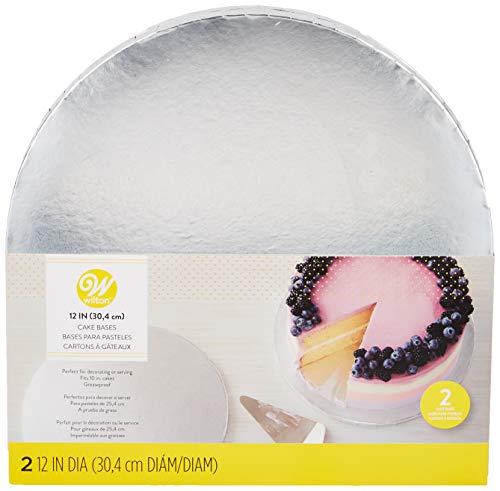
Wilton Silver 12 Inch Round Cake Bases, Grease-Resistant
Grease resistance, stated plainly by the manufacturer, is the specification that decides whether a board survives under a cake for more than a few hours, and plain cardboard boards do not carry it.
Best for: a cake that has to sit before it is served
Check price on AmazonBuy Wilton Silver 12 Inch Round Cake Bases, Grease-Resistant at $8.06 for any cake that has to sit before it is served. The specification worth checking on a cake board is grease resistance, not thickness: a plain cardboard round left under a buttercream or ganache filled cake goes translucent and soft within a day, no matter how thick it started out, because fat migrates through untreated paper stock.
Board size follows a simple convention: the cake's diameter plus 2 inches, which leaves an inch of margin all round to lift the cake by. An 8 inch cake wants a 10 inch board; run any other size through the cake board and box calculator.
What board does a first cake need?
For a cake served the same day it is finished, grease resistance matters less, and a pack of plain boards in the size you actually bake at is the cheapest way to always have one on hand.

Wilton 10 Inch White Cake Boards, 10 Count
$14.99A pack of 10 boards sized for an 8 inch cake, from a named maker rather than an unbranded multipack with no stated thickness, and cheap enough to always have a fresh one ready.
Best for: cakes that are decorated and served the same day
Check price on AmazonAmazon prices move often, so check before you buy.
What board fixes the real weak point in a cardboard round?
The moment a cake has to sit for more than a few hours, or travels before it is served, a plain board becomes the weak point, and grease resistance is the fix.
Wilton Silver 12 Inch Round Cake Bases, Grease-Resistant
$8.06Grease resistant is the specification stated on the board itself, which is what stops a rich buttercream or ganache filling from turning a cardboard round translucent and soft while the cake waits to be served.
Best for: a cake that has to sit before it is served
Check price on AmazonAmazon prices move often, so check before you buy.
What is worth buying for large or heavy tiers?
A board is only as useful as your ability to move the cake sitting on it, and past a certain size that becomes the actual bottleneck.

Fat Daddio's Stainless Steel Jumbo Spatula and Cake Lifter, 16.5 in
$26.69At 16.5 inches long this lifts a 14 inch tier on its board without the middle sagging, which is past the point where a 10 inch lifter or a pair of hands will support the cake evenly.
Best for: moving 12 and 14 inch tiers onto or off their boards
Check price on AmazonAmazon prices move often, so check before you buy.
Who should not buy this
Not for anyone working in 6 to 10 inch single tiers. A jumbo lifter this long is unwieldy on a small cake and costs more than most people will use it enough to justify; a standard offset spatula or a 10 inch lifter handles anything up to about a 10 inch tier without trouble.
How do these compare?
| Product | Diameter | Grease resistant? | Count | Price |
|---|---|---|---|---|
| Wilton white cake boards | 10 in | Not stated | 10 | $14.99 |
| Wilton silver grease resistant bases | 12 in | Yes, stated | 2 | $8.06 |
| Wilton lace doily cake circles | 12 in | Not stated | 8 | $7.99 |
| Nordic Ware cake lifter | 10 in | Not applicable | 1 | $25.99 |
| Fat Daddio's jumbo lifter | 16.5 in long | Not applicable | 1 | $26.69 |
What is a cake drum, and is one worth buying?
A drum is a thicker, rigid board, typically around half an inch of pressed board under a foil or laminate wrap, used under a heavy tiered cake where a single sheet of cardboard would flex. Search results for cake drums are almost entirely the same unbranded product under rotating seller names, the same pattern seen with acetate collars and acrylic discs elsewhere on this site, so no drum is named as a pick here. Judge one on stated thickness and covering rather than brand: search a half inch drum and confirm the listing states both the board thickness and whether it is foil or laminate wrapped before buying, since a listing that omits both is the sign of an unbranded pack with no real specification behind it.
A single cake board serves a single tier fine on its own. A drum earns its extra cost and weight specifically under the bottom tier of a stack, where the combined weight of every tier above rests on that one board through however many dowels are supporting the stack, and a board that flexes even slightly there transmits a tilt to everything stacked on top of it.
How we chose
These picks come from published manufacturer specifications (dimensions, materials, capacity) and the consensus of verified owner reviews on how well a stand, carrier or box actually holds up in use. Nothing here was used in person to transport, box or display a cake for this page, and none of it is a substitute for measuring your own cake before you buy.
Where a whole category is dominated by interchangeable, unbranded listings, such as cake drums, that is stated plainly rather than papered over with a confident-sounding pick, in keeping with the standing rule for this catalog: a product is named only when a real manufacturer stands behind it.
Buying tips
Check the stated grease resistance before checking the price. A board that does not mention it is very likely plain cardboard, which is fine for a cake eaten within a few hours and a real liability for one that has to sit overnight or travel to a venue ahead of time.
Size the board to the cake, not to the platter you plan to serve it on: the convention is the cake's diameter plus 2 inches, which gives an inch of margin all round to lift the finished cake by without touching the sides. A board cut exactly to the cake's diameter leaves no margin at all and forces you to lift the cake itself rather than its board.
For a tiered cake, every board under a tier other than the top one is also a structural part of the stack, not just a serving surface, and needs the same grease resistance as a single-tier board plus the rigidity to carry the weight above it without bowing. A thin board flexing under a heavy upper tier is a common cause of a stack leaning, and it is a board problem more often than a dowel problem, so a grease resistant board with real rigidity, or a drum for anything past two tiers, is worth the extra cost on the tiers doing the carrying. Work out the dowel count and ring size each tier needs separately in the tier support calculator, since the board and the dowels are solving two different problems: the board resists bowing across its whole face, and the dowels carry the point load of everything stacked above.
A few things worth knowing before any of this leaves the kitchen. Anything filled or coated with whipped cream or cream cheese needs refrigeration, and buttercream softens in a warm room long before it is unsafe, which is a structural problem rather than a health one. A ganache made soft, with more cream in it, is far less stable sitting out than a firm dark ganache made mostly of chocolate. Ask about allergies before you bake for other people, since cross contact happens at the mixing bowl rather than the table, and if you are selling rather than giving cakes away, that is governed by your state cottage food law, which varies a great deal.
What this job actually needs
Wilton Silver 12 Inch Round Cake Bases, Grease-Resistant
$8.06Grease resistant is the specification that matters: a plain cardboard round goes translucent and soft under a buttercream cake within a day.
Best for: a cake that has to sit before it is served
Check price on AmazonAmazon prices move often, so check before you buy.
Wilton 10 Inch White Cake Boards, 10 Count
$14.99A 10 inch board is the right size under an 8 inch cake, leaving an inch of margin all round to lift by, and this is the branded version of a category dominated by unbranded packs.
Best for: boards under 8 inch cakes
Check price on AmazonAmazon prices move often, so check before you buy.
Fat Daddio's Stainless Steel Jumbo Spatula and Cake Lifter, 16.5 in
$26.69At 16.5 inches it lifts a 14 inch tier, which is past the point where anything smaller will support the middle.
Best for: lifting 12 and 14 inch tiers
Check price on AmazonAmazon prices move often, so check before you buy.
Questions people ask
- What size board do I need for an 8 inch cake?
- A 10 inch board. The convention is the cake's diameter plus 2 inches, which leaves an inch of margin all round to lift the finished cake by without your hands touching the sides. This scales the same way at every size: a 6 inch cake wants an 8 inch board, and a 10 inch cake wants a 12 inch board.
- Why did my cake board go soft and see-through?
- The board was plain cardboard without grease resistance, and fat from a buttercream or ganache filling migrated through the paper stock over time, which is a matter of hours rather than days under a rich filling. A board explicitly labeled grease resistant, such as Wilton's silver cake bases, is treated to stop exactly this.
- What is the difference between a cake board and a cake drum?
- Thickness and rigidity. A standard cake board is a thin sheet of cardboard, fine for a single tier served the same day. A drum is roughly half an inch thick, wrapped in foil or laminate, and is meant to sit under a heavy tiered cake without flexing under the combined weight of everything above it.
- Can I reuse a cake board?
- Only if it never touched the cake directly, since fat and moisture from frosting soak into the board even a grease resistant one is meant to resist for the length of one event, not indefinitely. Treat every board as single use once frosting has touched it, and keep a stack of the sizes you bake most often on hand.
- Why is there no specific cake drum recommended on this page?
- Because searching for one returns almost entirely the same unbranded product sold under different seller names, with no manufacturer standing behind any particular listing, which matches what happened when this catalog checked acetate collars and acrylic discs. Buy a drum on stated thickness, around half an inch, and covering material rather than on a brand name that does not really exist in this category.
Related pages
How this page was put together
Researched from pan geometry, published manufacturer capacities, published serving conventions and university extension guidance. Not hands-on testing, and not professional advice.
Figures are labelled as derived, published or trade convention. Where no honest figure exists, the page says so rather than filling the gap.