Quick answer
The Martha Stewart Watercrest glass cake stand, $49.99, is a 10.2 inch footed plate with a dome, sized to hold an 8 or 9 inch cake on its board with a small margin. A cake stand needs to fit the cake's board, not just the cake itself, since the board is what actually rests on the plate.

Martha Stewart Watercrest Glass Cake Stand with Dome, 10.2 in
A 10.2 inch plate with a dome covers an 8 or 9 inch cake on its board and protects the surface from drying out while it waits to be cut, which a plate without a dome cannot do.
Best for: 8 and 9 inch cakes with a cover
Check price on AmazonFor most home sized cakes, Martha Stewart Watercrest Glass Cake Stand with Dome, 10.2 in at $49.99 is the stand to buy: a 10.2 inch footed glass plate with a dome, sized to actually hold an 8 or 9 inch cake on its board rather than just the cake itself.
That distinction is the one buying mistake worth avoiding. A cake never sits directly on a stand; it sits on its board, and the board is the cake's diameter plus 2 inches by convention. An 8 inch cake needs a 10 inch board underneath it, so a stand plate has to clear 10 inches, not 8, or the board overhangs the edge.
What stand covers a first cake?
For a first stand, a large plain plate without a dome is the simplest and cheapest option, and it suits a cake that is going to be cut and served soon after it arrives at the table.
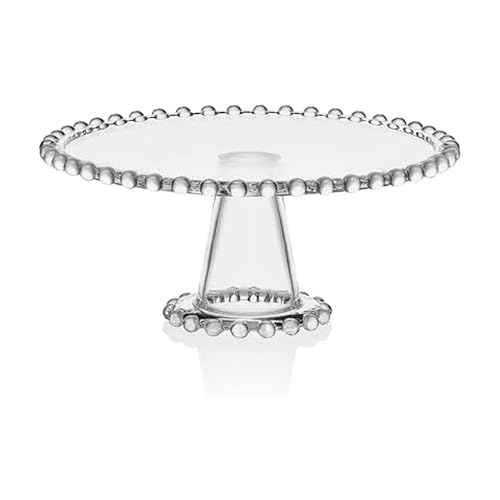
Fitz and Floyd Beaded Glass Cake Stand, 10.75 in
$39.99A 10.75 inch beaded glass plate, the largest and least expensive of the three stands here, with no dome to manage, which is exactly right for a cake that will be cut within an hour or two of being displayed.
Best for: a first cake stand for cakes served soon after display
Check price on AmazonAmazon prices move often, so check before you buy.
What stand fixes the real weak point, a cake drying out on display?
Once a decorated cake has to sit out for a while before it is cut, buttercream and cut cake edges both dry and crust in open air, and a dome is the fix.
Martha Stewart Watercrest Glass Cake Stand with Dome, 10.2 in
$49.99The dome buys real time: an uncovered buttercream cake starts to crust within a couple of hours, and a footed 10.2 inch plate underneath fits an 8 or 9 inch cake on its board with a small margin.
Best for: a decorated cake on display for several hours before cutting
Check price on AmazonAmazon prices move often, so check before you buy.
What stand is worth the extra cost?
Past protecting the cake, a stand can also be a genuine piece of serving glassware worth owning for its own sake, and that is where the price climbs a little further.

Libbey Selene Glass Cake Stand with Dome Lid
$54.99A footed glass server with a dome that reads as tableware rather than equipment, worth the extra cost for someone who entertains often enough that the stand itself is on display as much as the cake is.
Best for: frequent entertaining where the stand is also the tableware
Check price on AmazonAmazon prices move often, so check before you buy.
Who should not buy this
Not for a one-off party or a cake headed to someone else's house. If the stand is only going to be used once or twice, the cheaper Fitz and Floyd plate does the same essential job of holding the cake up for less money, and a stand meant to double as everyday serving glassware is wasted on a single use.
How do these compare?
| Stand | Plate diameter | Dome included? | Material | Price |
|---|---|---|---|---|
| Fitz and Floyd beaded glass stand | 10.75 in | No | Glass | $39.99 |
| Martha Stewart Watercrest stand | 10.2 in | Yes | Glass | $49.99 |
| Libbey Selene glass stand | Not stated by the maker | Yes | Glass | $54.99 |
How we chose
These picks come from published manufacturer specifications (dimensions, materials, capacity) and the consensus of verified owner reviews on how well a stand, carrier or box actually holds up in use. Nothing here was used in person to transport, box or display a cake for this page, and none of it is a substitute for measuring your own cake before you buy.
Where a whole category is dominated by interchangeable, unbranded listings, such as cake drums, that is stated plainly rather than papered over with a confident-sounding pick, in keeping with the standing rule for this catalog: a product is named only when a real manufacturer stands behind it.
Buying tips
Measure the board, not the cake, before buying a stand. An 8 inch cake sits on a 10 inch board by convention, so a stand plate needs to clear 10 inches with a little room, not 8. Run the cake board and box calculator for the board size your cake actually needs before you check a stand's stated plate diameter against it.
A dome is worth it for anything decorated more than an hour or two before it is cut, since open buttercream crusts and a cut edge dries visibly in that time. It is not worth it for a cake that goes straight from decorating to the table, where the dome only adds something to store and something that can fog with condensation if the cake went from a fridge into a warm room.
Footed stands raise the cake's visual height, which matters for photographs and a table display, but they also raise the center of gravity of a heavy tiered cake. For anything past a single tier, a low, stable stand or a plain board on the table is a safer choice than a tall pedestal, and a stand with a wide, heavy foot resists tipping far better than a narrow one, regardless of material.
Glass shows a cake board's raw edge more than a solid colored ceramic plate does, since you can see straight through the rim to whatever is underneath the cake. A board with a printed doily edge, or one trimmed neatly to size, looks deliberate on a glass stand; an untrimmed corrugated edge does not, and it is worth the extra minute to tidy a board before it goes on display glassware. Clean a glass stand with a standard glass cleaner rather than an abrasive pad, since the beaded and etched patterns on stands like the Fitz and Floyd trap residue that a rough cloth will not fully clear.
A stand on a tablecloth or a slick rented tabletop can slide more than the same stand on a bare kitchen counter, since the foot that grips fine on laminate can skate on fabric or polished stone. A thin non-slip pad cut to the foot's shape, the kind sold for lining cabinet shelves, fixes this cheaply and is worth packing alongside the stand itself for any cake going to a venue rather than staying in your own kitchen.
Match the stand to how the cake will actually be handled at the end of the event. A stand with a dome makes for a dramatic reveal but has to be lifted off before the first slice, which needs a clear flat surface nearby to set it on; a plain plate skips that step entirely, which matters more than it sounds like at a crowded table with nowhere obvious to put a large glass dome down.
A few things worth knowing before any of this leaves the kitchen. Anything filled or coated with whipped cream or cream cheese needs refrigeration, and buttercream softens in a warm room long before it is unsafe, which is a structural problem rather than a health one. A ganache made soft, with more cream in it, is far less stable sitting out than a firm dark ganache made mostly of chocolate. Ask about allergies before you bake for other people, since cross contact happens at the mixing bowl rather than the table, and if you are selling rather than giving cakes away, that is governed by your state cottage food law, which varies a great deal.
What this job actually needs
Martha Stewart Watercrest Glass Cake Stand with Dome, 10.2 in
$49.99A footed stand with a dome at a 10.2 inch plate size, which fits an 8 or 9 inch cake with the margin that makes a cake look deliberate rather than squeezed.
Best for: 8 and 9 inch cakes with a cover
Check price on AmazonAmazon prices move often, so check before you buy.
Fitz and Floyd Beaded Glass Cake Stand, 10.75 in
$39.99A 10.75 inch plate takes a 10 inch cake with a margin, which is the size most pedestal stands are not, since many are sized for a 9 inch and overhang.
Best for: presenting a 10 inch cake
Check price on AmazonAmazon prices move often, so check before you buy.
Libbey Selene Glass Cake Stand with Dome Lid
$54.99The dome is the functional part: a buttercream cake left uncovered goes crusty on the surface within hours, and a dome buys you a day.
Best for: serving and keeping a cake in one piece of glassware
Check price on AmazonAmazon prices move often, so check before you buy.
Questions people ask
- What size cake stand do I need for an 8 inch cake?
- A plate at least 10 inches across, because the cake sits on its board rather than directly on the stand, and an 8 inch cake needs a 10 inch board by the standard convention of diameter plus 2 inches. A stand sized only to the cake itself will leave the board overhanging the edge.
- Do I need a dome on a cake stand?
- If the cake will sit out for more than an hour or two before it is cut, yes. Buttercream crusts and cut edges dry noticeably in open air over that time, and a dome slows both. For a cake that goes straight from decorating to serving, a dome adds little and is one more thing to store.
- Is glass or ceramic better for a cake stand?
- Both work; the practical difference is weight and how easily you can see the cake's underside while placing it. Glass stands let you see through the plate to line the cake up centrally, which ceramic does not, and glass is generally lighter for the same plate diameter, which matters for a tall pedestal stand.
- Can I put a fondant covered cake in the refrigerator on its stand?
- Better to chill the cake separately before it goes onto a decorative stand, if it needs to be chilled at all. Condensation forms on a cold cake as it warms back up in room air, and that moisture pits and streaks a fondant surface. A stand with a dome traps that moisture against the cake rather than letting it evaporate away.
- Why does my cake look too small on its stand?
- Usually the stand plate is a couple of inches larger than the board underneath the cake, which leaves visible bare glass around the base. This is partly unavoidable, since the plate has to clear the board, but a stand sized close to the board rather than far past it will minimize the gap.
Related pages
How this page was put together
Researched from pan geometry, published manufacturer capacities, published serving conventions and university extension guidance. Not hands-on testing, and not professional advice.
Figures are labelled as derived, published or trade convention. Where no honest figure exists, the page says so rather than filling the gap.