Quick answer
Heat egg white and sugar together over a bain-marie until the sugar fully dissolves, whip that to a stiff, cooled meringue, then beat in softened butter a piece at a time. The mixture will turn soupy and then curdled partway through the butter stage. That is normal and it smooths out once the temperature evens across the bowl.

OXO Good Grips Silicone Heat Resistant Spatula Set, 3 Piece
Heat resistant silicone is required for Swiss meringue over a bain-marie, where a plain rubber spatula degrades and leaves marks in the bowl.
Best for: folding batter and working over heat
Check price on AmazonSwiss meringue buttercream is built in three stages, and the middle stage looks like a mistake even when it is going perfectly. Egg white and sugar are heated together over a bain-marie, not to cook the eggs, but to dissolve the sugar and warm the whites enough that they whip into a stable, marshmallow-like foam. That hot mixture is then whipped to a stiff, glossy meringue and left to cool back to room temperature. Softened butter goes in last, a piece at a time, and this is where the buttercream turns soupy and then curdled before it comes together smooth and silky.
Compared with American buttercream, which is just butter beaten with powdered sugar, Swiss meringue buttercream takes longer and asks for a bit more equipment, but it rewards that with a finish that is far less sweet, silkier on the tongue, and stable enough to hold clean piped shapes in a warm room. For the quantity a given cake actually needs, see the frosting quantity reference or run your own cake through the buttercream batch calculator. For coloring the finished buttercream, see how to color buttercream, and if a batch splits on you, how to fix split or curdled buttercream covers the fix in more depth than this page does.
How do I make Swiss meringue buttercream step by step?
Weigh everything on a kitchen scale rather than measuring egg whites by volume; a scale is the only way to know the sugar and egg white ratio is actually right, and it makes the recipe repeatable.
- Set up a bain-marie. Bring an inch of water to a bare simmer in a saucepan and set a stainless mixing bowl on top without letting the bowl touch the water. Add egg whites and sugar to the bowl.
- Heat and whisk until the sugar dissolves. Whisk more or less constantly with a heat resistant silicone spatula or a whisk, scraping the sides and floor of the bowl so nothing scrambles against the hot glass or metal. Rub a little of the mixture between two fingers every minute or so; when it feels completely smooth with no gritty sugar left, it is ready. This usually takes 8 to 10 minutes over gentle heat.
- Whip to a stiff, glossy meringue. Move the bowl to a stand mixer fitted with the whisk attachment and whip on medium-high until the meringue holds a stiff, glossy peak and the outside of the mixing bowl has cooled to close to room temperature. This can take 8 to 12 minutes; do not rush it by adding cold butter to a warm meringue, since that just melts the butter and sets the whole process back.
- Switch to the paddle and start adding butter. With the mixer on medium-low, add softened butter a few tablespoons at a time, letting each addition mostly incorporate before the next.
- Expect it to look soupy, then curdled. Partway through the butter, the mixture will loosen into a soupy puddle, and shortly after that it will look like broken, curdled cottage cheese. Keep the mixer running and keep adding butter. This is the normal shape of the process, not a sign that anything has gone wrong.
- Keep beating until it turns smooth. Once all the butter is in, continue on medium-high for another few minutes. The buttercream will suddenly pull together into a smooth, silky mass as the temperature of the butter and meringue evens out across the bowl.
- Add flavoring last, then beat briefly to combine. Vanilla, melted and cooled chocolate, or fruit reduction all go in once the buttercream is already smooth, followed by a minute on low speed to fully incorporate without beating in excess air.
Why does the buttercream look soupy and curdled while I'm adding the butter?
Both stages come down to temperature, not to a ruined batch. The meringue base needs to be close to room temperature and the butter also close to room temperature before they meet; if the meringue is still slightly warm when the first pieces of butter go in, those pieces melt and the mixture turns soupy. If the butter is colder than the meringue, or if the kitchen is cold enough that the butter firms up faster than it can emulsify, the mixture looks curdled and lumpy instead, like it has separated into solid flecks suspended in liquid.
Both states resolve the same way: keep the mixer running. As more butter goes in and the temperature of the whole mass averages out, the fat finally emulsifies into the meringue's egg proteins and water, and the buttercream turns glossy and smooth almost all at once. If it genuinely refuses to come together after several minutes of continuous beating, the fix is a brief, deliberate warm-up or chill-down rather than more beating on its own; see how to fix split or curdled buttercream for that in detail.
What should the meringue look like before I start adding butter?
Two things have to be true at once: the meringue holds a stiff, glossy peak when the whisk is lifted, and the outside of the mixing bowl feels close to room temperature rather than warm. Whipping in butter while the meringue is still warm is the single most common cause of a soupy start. If the bowl is slow to cool on its own, a few minutes in the refrigerator speeds that along.
If the meringue will not hold a peak at all after several minutes of whipping, the likely cause is a trace of fat or egg yolk in the whites, since even a small amount interferes with the proteins that hold the foam together.
What if my Swiss meringue buttercream will not come together?
| Symptom | Likely cause | Fix |
|---|---|---|
| Soupy after adding butter | Meringue or butter too warm | Keep beating; chill the bowl briefly against ice water if it is not progressing |
| Curdled, lumpy appearance | Butter colder than the meringue | Keep beating on medium-high; warm the outside of the bowl with a warm cloth if it stalls |
| Meringue won't hold a stiff peak | Trace of fat or yolk in the egg whites, or bowl not fully clean | Start again with a scrupulously clean, dry bowl and whisk |
| Buttercream looks greasy or oily | Butter added too fast, or overheated during the meringue stage | Stop adding butter, beat on high until it re-emulsifies, then continue more slowly |
| Too soft to pipe | Kitchen is warm, or butter was too soft going in | Chill the whole bowl 10 to 15 minutes, then rewhip on medium until it firms back up |
How is Swiss meringue buttercream different from American buttercream?
American buttercream is just butter beaten with powdered sugar and a little liquid, fast and forgiving but noticeably sweet and slightly grainy from the powdered sugar. Swiss meringue buttercream dissolves its sugar into the egg white before any butter goes in, so the finish is smooth rather than gritty and considerably less sweet. The tradeoff is time: it needs a bain-marie step, a stand mixer with real whipping power, and patience through the soupy and curdled stages that American buttercream never goes through. Both pipe cleanly once finished, but Swiss meringue buttercream holds a crisper edge on borders and rosettes. For rough quantities either way, the frosting quantity reference works the same for both.
What this job actually needs
OXO Good Grips Silicone Heat Resistant Spatula Set, 3 Piece
$23.95Heat resistant silicone is required for Swiss meringue over a bain-marie, where a plain rubber spatula degrades and leaves marks in the bowl.
Best for: folding batter and working over heat
Check price on AmazonAmazon prices move often, so check before you buy.

KitchenAid Artisan 5 Quart Tilt-Head Stand Mixer (KSM150PS)
$399.99The default decorating mixer: 10 speeds down to a stir that folds rather than throws, a 5 quart bowl rated for 9 cups of flour, and the tilt head that makes scraping a buttercream bowl quick.
Best for: the buy-once home mixer for cakes and buttercream
Check price on AmazonAmazon prices move often, so check before you buy.
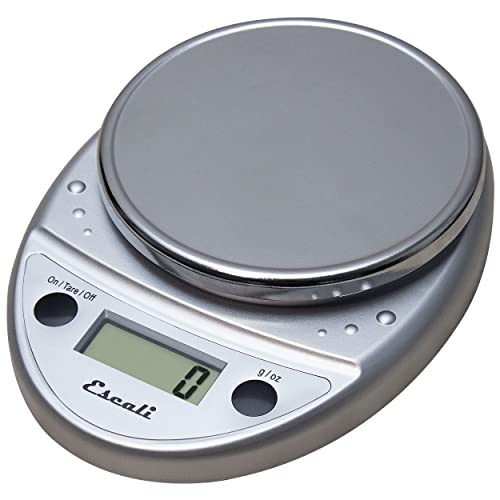
Escali Primo Digital Food Scale
$25.00The scale most often on a professional bench: it reads fast, tares instantly, and nothing about it is trying to also be a nutrition tracker.
Best for: weighing every ingredient, which is what makes scaling a recipe work
Check price on AmazonAmazon prices move often, so check before you buy.
Questions people ask
- Can I make Swiss meringue buttercream with a hand mixer instead of a stand mixer?
- Yes, but expect the whipping stage to take longer and your arm to get tired holding the mixer steady over several minutes. A hand mixer has less power than a stand mixer, so whipping the hot meringue to stiff peaks and later beating in the butter both take extra time. It works fine for a small batch; a stand mixer is worth it once you are making buttercream regularly or in large quantities.
- Do I need a candy thermometer to make Swiss meringue buttercream?
- Not strictly. The reliable test is texture, not a number: rub a small amount of the heated egg white and sugar mixture between two fingers, and once it feels completely smooth with no gritty sugar crystals left, it is ready to come off the heat. A thermometer can confirm the mixture is warm enough to whip well, but the finger test is the one that actually tells you the sugar has dissolved.
- Why did my Swiss meringue buttercream never come together, even after a long time beating?
- This usually means the temperature gap between the meringue and the butter was too extreme in one direction to close by beating alone. Very cold butter added to a meringue that has already cooled fully can take an unusually long time to emulsify. Warming the outside of the bowl briefly with a warm, damp cloth while continuing to beat on medium-high speed almost always brings it together within another minute or two.
- Can Swiss meringue buttercream be flavored with chocolate or fruit?
- Yes. Melted chocolate should be fully cooled to close to room temperature before it goes in, since hot chocolate melts the butter structure the same way hot meringue does. Fruit purees and reductions work well too, but should be cooked down and cooled first to remove excess water, since raw fruit juice can thin the buttercream or cause it to separate.
- Why is my finished Swiss meringue buttercream too soft to pipe?
- The most common cause is a warm kitchen or butter that was softer than intended going into the mixing bowl. Chill the whole bowl of finished buttercream in the refrigerator for 10 to 15 minutes, then rewhip it on medium speed until it firms back up to a pipeable consistency. Repeat the short chill and rewhip cycle if the room is especially warm.
Related pages
How this page was put together
Researched from pan geometry, published manufacturer capacities, published serving conventions and university extension guidance. Not hands-on testing, and not professional advice.
Figures are labelled as derived, published or trade convention. Where no honest figure exists, the page says so rather than filling the gap.