Quick answer
A springform pan wins for anything that must come out without inverting, cheesecake, mousse cake and delicate crustless bakes, because its hinged wall opens away from the cake entirely. A loose bottom pan has no seam at the wall and will not leak the way a springform's clamp can, but the cake still gets pushed up from below.

Nordic Ware Springform Pan, 9 in, 10 Cup Capacity, 2 Piece Set
A published 10 cup capacity, which is the figure you actually need when substituting a cheesecake recipe into a different pan, and two pans so a layered cheesecake can chill in parallel.
Best for: cheesecakes and mousse cakes
Check price on AmazonA springform pan such as Nordic Ware Springform Pan, 9 in, 10 Cup Capacity, 2 Piece Set is a solid base disc with a separate ring wall that clamps shut around it with a latch, and opening that latch releases the wall entirely, leaving the cake standing free on the base. A loose bottom pan is built the other way around: the wall is one solid piece with no seam or latch at all, and a flat disc sits loosely inside it, resting on a small lip near the bottom, so the cake comes out by pushing that disc up and out through the top rather than by opening anything.
This catalog does not carry a dedicated loose bottom pan, since springform pans have become the default for the same jobs in most home kitchens, but the mechanical trade-offs below hold regardless of which brand actually makes either style. Compare any pan's capacity directly in the pan substitution calculator.
What's mechanically different between the two?
A springform's wall and base are two separate pieces held together only by tension from the latch, which is what lets the wall lift straight off sideways once released. A loose bottom pan's wall is a single uninterrupted ring, with the base simply dropped in rather than clamped, so nothing about the wall itself ever opens; the cake has to travel up and out through the top of that fixed ring instead.
Which one actually leaks less in a water bath?
Counterintuitively, the loose bottom pan usually leaks less, precisely because it has no seam at the wall the way a springform's latch does. A springform's clamp closes tightly enough for most batters, but the joint where the base meets the wall is a real seam, which is why the standard advice for cheesecake in a springform is to wrap the outside in foil before it ever touches a water bath. A loose bottom pan's disc can still let a very thin batter seep underneath if it is not seated flush, but it has no hinge or latch gap to fail in the first place.
Does a springform pan hold the same amount as a plain round pan?
| Size | Depth (in) | Area (sq in) | Rim capacity (cups) | Batter at 2/3 fill (cups) |
|---|---|---|---|---|
| 8 in springform | 3 | 50.27 | 10.45 | 6.96 |
| 9 in springform | 3 | 63.62 | 13.22 | 8.81 |
| 10 in springform | 3 | 78.54 | 16.32 | 10.88 |
Which one should you use for a layered cake instead of a cheesecake?
A firm layer cake batter, the kind that already releases cleanly from a plain round pan with grease and flour, gains little from either specialty pan and is usually better baked in a standard round to avoid the extra seam a springform introduces. Both styles genuinely earn their keep on delicate bakes: a crustless cheesecake or mousse cake that cannot be inverted needs a springform's opening wall, while a tart or a cake meant to be pushed up onto a serving stand suits a loose bottom pan's push-through release.
So which should you buy?
Nordic Ware Springform Pan, 9 in, 10 Cup Capacity, 2 Piece Set covers most cheesecake and mousse cake needs at a 9 inch, 10 cup published capacity, and Wilton Gold Non-Stick Springform Pan Set, 8, 9 and 10 in adds 8 and 10 inch sizes in one purchase for recipes that specify a different size. Hiware 9 Inch Non-Stick Springform Pan with Removable Bottom is the budget entry if you bake a crustless cheesecake only occasionally. Whichever springform you buy, plan on a foil wrap for anything going into a water bath, since the seam at the latch is the one real weakness of the design.
What this job actually needs
Nordic Ware Springform Pan, 9 in, 10 Cup Capacity, 2 Piece Set
$18.00A published 10 cup capacity, which is the figure you actually need when substituting a cheesecake recipe into a different pan, and two pans so a layered cheesecake can chill in parallel.
Best for: cheesecakes and mousse cakes
Check price on AmazonAmazon prices move often, so check before you buy.

Wilton Gold Non-Stick Springform Pan Set, 8, 9 and 10 in
$28.09Three springform sizes at once, made without PFAS, which covers nearly every cheesecake recipe without having to rescale one.
Best for: baking cheesecakes at whatever size the recipe says
Check price on AmazonAmazon prices move often, so check before you buy.
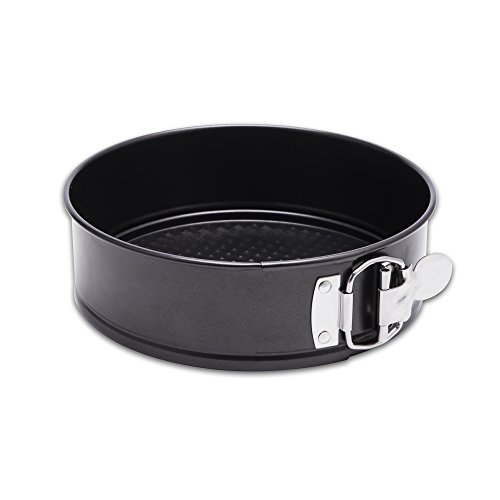
Hiware 9 Inch Non-Stick Springform Pan with Removable Bottom
$15.99The cheapest leakproof springform worth owning, though any springform benefits from a foil wrap in a water bath because the seam is a seam.
Best for: an occasional cheesecake
Check price on AmazonAmazon prices move often, so check before you buy.
Questions people ask
- Is a springform pan the same size as a regular round cake pan?
- Yes, its interior is a plain circle with exactly the same area and volume as a solid round pan of the same diameter and depth. A 9 inch springform holds the same 13.22 cups to the rim as a 9 inch solid round pan 3 inches deep; the removable latched wall changes how the cake comes out, not how much batter the pan holds.
- Does a springform pan leak batter?
- It can, at the seam where the base meets the clamped wall, which is a real joint rather than a solid piece of metal. This is why cheesecake recipes baked in a water bath almost always call for wrapping the outside of a springform in foil first, since the water bath puts direct pressure on exactly the seam most likely to let a thin batter seep through.
- Can I use a springform pan for a normal layer cake?
- Yes, a firm cake batter bakes in a springform exactly as it would in a solid round pan of the same size, since the interior geometry is identical. It is not usually necessary, since a firm batter already releases cleanly from a plain pan with grease and flour, and a springform adds a seam with no real benefit for a batter that was never going to leak in the first place.
- Why do recipes say to wrap a springform pan in foil?
- Because the joint between the removable wall and the base is a real seam, not a solid surface, and it is the point most likely to let water in during a water bath or let batter seep out before baking. Wrapping the outside of the pan in one or two layers of heavy foil seals that seam well enough for most cheesecake and custard bakes.
Related pages
How this page was put together
Researched from pan geometry, published manufacturer capacities, published serving conventions and university extension guidance. Not hands-on testing, and not professional advice.
Figures are labelled as derived, published or trade convention. Where no honest figure exists, the page says so rather than filling the gap.