Quick answer
A cake board is thin card, meant to sit under one tier inside a stack where dowels carry the real weight. A cake drum is about half an inch thick and rigid, meant to sit under the whole finished cake for presentation and transport. A single cake needs a drum, not a board, once it has to travel.
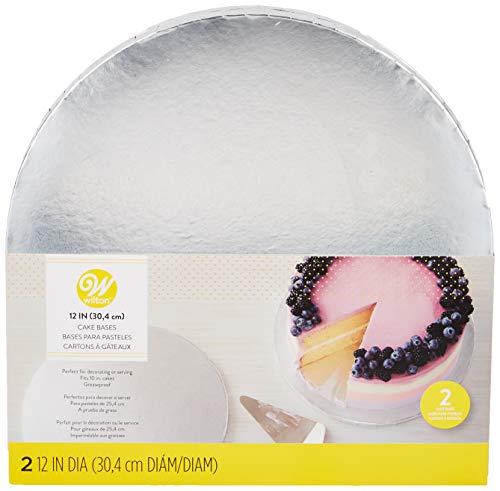
Wilton Silver 12 Inch Round Cake Bases, Grease-Resistant
Grease resistant is the specification that matters: a plain cardboard round goes translucent and soft under a buttercream cake within a day.
Best for: a cake that has to sit before it is served
Check price on AmazonBoth are round or square pieces of covered board under a cake, and the confusion between them is understandable, but they carry different loads for different reasons. A cake board is thin, closer to a sixteenth to an eighth of an inch, and its job inside a tiered stack is limited: it lets you lift and place one tier without touching the cake directly, while the actual weight of everything above it is carried by dowels and a separator plate, not by the board. A cake drum is thick, conventionally about half an inch, rigid fiberboard or a similarly stiff material, and its job is to support the entire finished cake by itself, on a table and in a car, without bowing.
The specification that matters on both, regardless of thickness, is grease resistance. A plain, uncoated cardboard round goes translucent and soft under a buttercream cake within a day, which is exactly the failure a grease-resistant board is built to avoid. Board size itself is a simple, computed convention: the board's diameter is the cake's own diameter plus 2 in of margin to lift it by, worked out for any size in the cake board and box calculator.
What is actually different between a cake board and a cake drum?
The distinction is thickness and job, not decoration or brand, and the table below lays out both.
| Specification | Cake board | Cake drum |
|---|---|---|
| Typical thickness | About 1/16 to 1/8 in, thin card | About 1/2 in, rigid |
| Sits under | One tier, inside a stack | The entire finished cake |
| Carries the weight of | Only that one tier, briefly, while placing it | The whole cake, on a table and in transit |
| Grease resistance needed | Yes; a coated surface stops sogginess | Yes, plus real structural rigidity |
| Bends under a heavy cake | Expected; it is not meant to span unsupported | Should not; that is its entire purpose |
| Typically bought | In multi-packs, by the dozen | One at a time, sized to the cake |
What size board or box does a given cake need?
Board size follows the cake's diameter plus a fixed margin; box size follows the board plus the cake's height, rounded up to the nearest whole inch since boxes are only sold in whole-inch sizes.
| Cake diameter (in) | Board size (in) | Box footprint (in) | Box height (in) |
|---|---|---|---|
| 6 | 8 | 9 x 9 | 6 |
| 8 | 10 | 11 x 11 | 6 |
| 9 | 11 | 12 x 12 | 6 |
| 10 | 12 | 13 x 13 | 6 |
| 12 | 14 | 15 x 15 | 6 |
| 14 | 16 | 17 x 17 | 6 |
Why does a stacked cake need a rigid drum underneath?
Because the weight adds up fast, and dowels only solve the problem between tiers, not underneath the whole stack.
| Cake | Approx weight (lb) |
|---|---|
| 10 in round, 2 layers | 9.3 |
| 12 in round, 2 layers | 13.4 |
| 3 tier stack, 6 + 8 + 10 in, 2 layers each | 18.7 |
Does the board under an individual tier need to be as thick as the drum?
No, and making every board drum-thick is mostly wasted weight and cost. Inside a stack, dowel rods driven down through the cake below and a rigid separator plate sitting on top of them are what actually carry an upper tier's weight, spreading it across the whole ring of dowels rather than concentrating it on a thin board. The board under that tier only has to survive being lifted and set into place once, which a thin, grease-resistant board handles without trouble.
The bottom of the whole stack is the exception, because nothing below it shares the load, and that is exactly where the half-inch drum belongs. A flat lifter still earns its place for moving a finished tier onto its board cleanly before assembly, since a board that flexes while a tier is being placed on it can crack a delicate layer just as easily as an undersized one.
Before this cake leaves the kitchen
Grease resistance is a presentation and structural question here, not a food safety one; a board or drum that goes soft under a cake is a mess to clean up rather than a health risk, provided the coating itself is food-safe as labeled. What is a genuine food safety matter is whatever is under the icing, not the board: a cream cheese or fresh cream filling still needs refrigeration regardless of how rigid the base underneath it is. If a cake is being sold rather than given away, that is governed by your state's cottage food law, which varies and often has its own rules about what a cake can be transported and displayed on.
What this job actually needs
Wilton Silver 12 Inch Round Cake Bases, Grease-Resistant
$8.06Grease resistant is the specification that matters: a plain cardboard round goes translucent and soft under a buttercream cake within a day.
Best for: a cake that has to sit before it is served
Check price on AmazonAmazon prices move often, so check before you buy.

Wilton 10 Inch White Cake Boards, 10 Count
$14.99A 10 inch board is the right size under an 8 inch cake, leaving an inch of margin all round to lift by, and this is the branded version of a category dominated by unbranded packs.
Best for: boards under 8 inch cakes
Check price on AmazonAmazon prices move often, so check before you buy.

Nordic Ware Cake Lifter, 10 in
$25.99A flat 10 inch disc slides under a finished tier without flexing, which is the difference between moving a cake and dropping it.
Best for: moving a finished tier onto its board
Check price on AmazonAmazon prices move often, so check before you buy.
Questions people ask
- What is the difference between a cake board and a cake drum?
- Thickness and job. A cake board is thin, roughly a sixteenth to an eighth of an inch, and its role inside a tiered stack is limited to letting you lift and place one tier, since dowels and a separator plate carry the real weight above it. A cake drum is thick, conventionally about half an inch and rigid, and it supports the entire finished cake by itself on a table and during transport, which a thin board is not built to do.
- What size cake board do I need for an 8 inch cake?
- A 10 inch board, which is the cake's own 8 inch diameter plus 2 inches of margin to lift it by, a standard trade convention. That margin is what lets you get a hand or a lifter underneath the board without touching the cake's frosted side. Larger cakes follow the same rule: add 2 inches to the cake's diameter to get the board size.
- Why does plain cardboard go soft under a cake?
- Because buttercream and other frostings are largely fat and moisture, and uncoated cardboard absorbs both readily, which is what turns it translucent and structurally weak within about a day. A grease-resistant board has a coating specifically meant to stop that absorption, which is the one specification that actually matters when choosing a board, far more than the printed pattern or color on top of it.
- Do I need a drum for a single, unstacked cake?
- If the cake is staying in one place on a table and being served from the board it was decorated on, a standard thin board is usually enough, since nothing is asking it to support the cake unsupported over a gap or through a bumpy transport. Once that same cake has to travel anywhere, in a car, up stairs, or handed off to someone else, a rigid drum underneath is the safer choice, since a thin board can flex enough in transit to crack the cake sitting on it.
- What size box do I need to transport a 10 inch cake?
- About a 13 by 13 by 6 inch box, for a 2 layer, 10 inch round cake on its 12 inch board. The box footprint clears the board by rounding its size up to the next whole inch, since boxes are sold only in whole-inch dimensions, and the height clears the cake's own roughly 3.71 inch finished height plus 2 inches of headroom, rounded up the same way.
Related pages
How this page was put together
Researched from pan geometry, published manufacturer capacities, published serving conventions and university extension guidance. Not hands-on testing, and not professional advice.
Figures are labelled as derived, published or trade convention. Where no honest figure exists, the page says so rather than filling the gap.