Quick answer
Mrs. Anderson's Baking Professional Cooling Rack, about $10.99, is the pick for cooling cake layers: heavy steel sized to a half sheet pan, so it also catches drips under a glaze or ganache. Buy a second one if you are turning layers out and flipping them right side up without touching a counter.
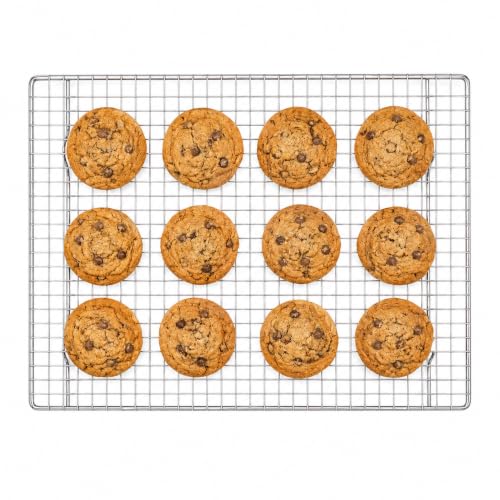
Mrs. Anderson's Baking Professional Cooling Rack, Heavy Duty Steel
Sized to sit inside a half sheet pan, it doubles as a drip rack for glazing and ganache rather than being a single-purpose cooling rack.
Best for: cooling layers and catching glaze
Check price on AmazonFor cooling cake layers, Mrs. Anderson's Baking Professional Cooling Rack, Heavy Duty Steel at $10.99 is the pick. Heavy steel construction, sized to fit inside a half sheet pan, which means it also works as a drip catcher under a glazed bundt or a ganache-covered cake.
A cooling rack is a genuinely simple tool, so this list is short and honest about it. There are two real branded products worth naming here, and past owning two or three of the same rack, there is nothing more expensive to buy.
What actually separates a good rack from a bad one is grid tightness and how flat the feet sit, not steel thickness alone. A rack with widely spaced wires can leave visible marks on a soft, still-warm layer, and one with uneven feet rocks on the counter every time you press down on it while turning a cake out.
What does a first cooling rack need to do?
One rack, sized to a half sheet pan, is enough for most home cake decorating.
Mrs. Anderson's Baking Professional Cooling Rack, Heavy Duty Steel
$10.99Sized to sit inside a half sheet pan, so it doubles as a drip rack for glazing and ganache instead of being a single purpose item.
Best for: cooling layers and catching glaze
Check price on AmazonAmazon prices move often, so check before you buy.
When do you need a second rack?
The moment you start turning a cake out of its pan and flipping it right side up, a single rack stops being enough, because the top of the layer touches a counter somewhere in that process.

Ultra Cuisine Cooling and Baking Rack Set, 11.5 x 16.5 in
$32.99Two racks, which is what you need to turn a cake out and then flip it back the right way up without the top ever touching a surface.
Best for: turning layers without marking the crust
Check price on AmazonAmazon prices move often, so check before you buy.
Is there an expert-level cooling rack?
Not as a single named product, and it would be dishonest to invent one. A cooling rack is a commodity: heavier steel and a tighter grid help a little, but the category tops out fast. What actually changes at real volume is quantity, not sophistication. A baker cooling several tiers or a full sheet cake at once typically buys three or four matching half sheet cooling racks rather than one specialized rack, so every layer has its own space to cool flat.
Who should not buy this
Buying a stack of matching racks is not for someone baking one cake at a time in a normal kitchen. The single Mrs. Anderson's Baking Professional Cooling Rack, Heavy Duty Steel or the two-piece Ultra Cuisine Cooling and Baking Rack Set, 11.5 x 16.5 in covers that job for a lot less counter space.
Does a cooling rack matter for anything besides cake layers?
Yes, and it is worth buying for these jobs even before you decide how many cakes a year you actually bake. A cooling rack over a sheet pan is the standard setup for glazing a bundt, drizzling icing on a loaf cake, or resting fried items and bacon, and it keeps a kitchen towel or a stack of parchment from soaking up grease directly on the counter.
It also doubles as a roasting rack for a small piece of meat or a tray of vegetables in a pinch, since the half sheet size fits the same pan either way. None of that changes which rack to buy, but it is part of why one rack, well chosen, earns its keep faster than most single-purpose baking tools.
For cookies, a rack shortens the time a tray needs to sit before you can move the cookies off the parchment, since the rack pulls heat away from the bottom faster than a hot pan left on a folded towel. It is a small thing on one batch and a real time saver across a full afternoon of baking for a bake sale or a holiday cookie exchange.
How do these compare on the numbers?
| Model | Fits | Pieces | Price |
|---|---|---|---|
| Mrs. Anderson's Baking Professional Cooling Rack | Half sheet pan | 1 | $10.99 |
| Ultra Cuisine Cooling and Baking Rack Set | 11.5 x 16.5 in | 2 | $32.99 |
How we chose
Both cooling racks above were researched from published manufacturer specifications: what pan size they are built to fit, grid density and piece count. The consensus of verified owner reviews was used to confirm which racks hold their shape under a hot pan and which warp or bend over time. Neither was tested in a kitchen for this page. This is researched from specifications and owner-review consensus, not a comparison performed in person.
A cooling rack is also one of the few tools on this site where the honest research finding is that the category has very little to differentiate on. Reviews for both products cluster around the same few points, whether the feet sit flat, whether the wires hold their shape under a hot pan, and whether the finish resists rust in a humid kitchen, and that consistency is itself part of the reason so few branded options are worth naming here.
Uncoated steel racks that see repeated contact with wet batter, glaze or syrup can develop surface rust over years of use, particularly if they are left wet after washing. That is a maintenance detail rather than a defect, and drying a rack promptly rather than letting it air dry in a damp sink avoids most of it.
Buying tips
Let a layer cool most of the way on the rack before frosting it. Warm cake melts buttercream on contact and drags crumbs into the finish coat, and a rack under the pan cools the bottom as fast as the top by letting air move on both sides.
A rack sized to a half sheet pan is worth the small extra cost over a generic round one, because parchment, silicone mats and sheet pans are all cut to that same size, so everything in the kitchen nests together instead of overhanging.
Once a cake is frosted with cream cheese or whipped cream frosting, refrigerate it rather than leaving it on the counter, and if the cake is going out for sale rather than as a gift, check your state cottage food law, since rules on baking and delivering from a home kitchen vary widely.
Wash a rack promptly after glazing or ganache work rather than letting sugar dry onto the wires, since dried sugar bonds to steel far more stubbornly than it does to a nonstick pan and can take real scrubbing to remove once it hardens.
What this job actually needs

Katbite Unbleached Parchment Paper Rounds, 8 in, 200 Count
$8.99Precut 8 inch rounds, because the single most common reason a layer tears coming out of the pan is that nobody lined the base.
Best for: lining 8 inch pans without cutting circles
Check price on AmazonAmazon prices move often, so check before you buy.

Wilton Bake-Even Cake Strips, 2 Piece Set
$10.99Damp strips around the pan slow the outside so the middle catches up, which is what stops a dome forming and saves you levelling off the top and throwing it away.
Best for: flat layers with no trimming
Check price on AmazonAmazon prices move often, so check before you buy.

Fat Daddio's Anodized Aluminum Round Cake Pans, 8 x 2 in, 2 Piece Set
$24.69Two matched 8 by 2 inch pans, which is exactly one two layer cake, in the anodized aluminum that bakes flatter than a dark nonstick pan because it reflects rather than absorbs.
Best for: the standard two layer 8 inch cake
Check price on AmazonAmazon prices move often, so check before you buy.
Questions people ask
- Why does a cake need to cool on a rack instead of the counter?
- Air needs to move under the pan or the layer, not just over it. A hot pan set directly on a counter traps steam against the bottom, which keeps that side soggy and can leave a ring on the counter. A rack lets air circulate on both sides so the whole layer cools at close to the same rate.
- Can I use a cooling rack to catch ganache drips?
- Yes, and it is one of the more useful second jobs a rack does. Set the cake on the rack over a sheet pan or a piece of parchment, pour the ganache or glaze, and the excess drips through the grid instead of pooling around the base of the cake, which keeps the finished edge clean.
- How long should a cake layer cool before frosting?
- At least an hour at room temperature for a standard 2 inch layer, and cooler is safer than warmer. Frosting a cake while it is even slightly warm melts buttercream on contact and drags crumbs through the coat. If you are short on time, a brief chill in the refrigerator after the initial cooling speeds things up safely.
- Do I need a rack for every layer, or can I stack them while cooling?
- Give each layer its own space if you can. Stacking warm layers traps steam between them, which can leave the touching surfaces damp and gummy. If you only own one rack, cool the layers in batches rather than stacking them two or three high on top of each other while still warm.
- Why did sugar or ganache stick to my cooling rack?
- Because it dried there before you washed it. Sugar syrup, glaze and ganache all set hard once they cool, and once that happens on bare steel wires it takes real scrubbing or a long soak to remove. Wipe or rinse a rack shortly after using it for glazing rather than leaving it to dry, and it will not accumulate a sticky buildup over time.
Related pages
How this page was put together
Researched from pan geometry, published manufacturer capacities, published serving conventions and university extension guidance. Not hands-on testing, and not professional advice.
Figures are labelled as derived, published or trade convention. Where no honest figure exists, the page says so rather than filling the gap.