Quick answer
Start checking a 9 inch round, 2 in deep pan at 30 minutes and expect 30 to 45 minutes at 350 F, with the pan filled two thirds and the batter 1.33 inches deep. This is a computed starting point from the pan geometry, not a tested time, and the doneness test decides.
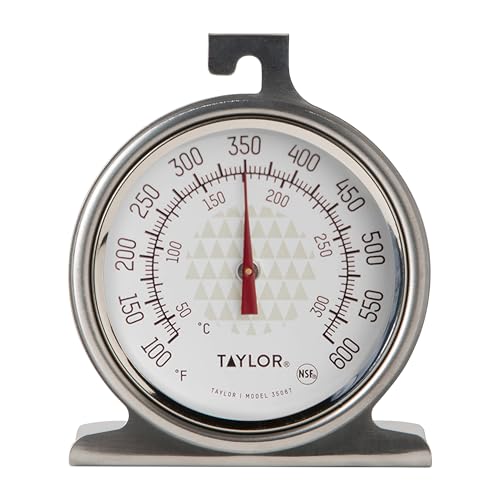
Taylor Large 2.5 Inch Dial Oven Thermometer
Home ovens routinely run 25 F or more off their dial, which is the real reason a bake time chart never matches your oven, and this is the cheapest way to find out by how much.
Best for: finding out what your oven actually does
Check price on AmazonA 9 inch round, 2 in deep pan filled two thirds full puts 1.33 inches of batter in the oven, and at 350 F that works out to roughly 30 to 45 minutes. Treat the low end as when to start looking, not when to take it out.
A word about where that range comes from, because it matters: nobody here baked a cake with a stopwatch. It is computed from the pan geometry using the formula below, and home ovens vary by more than the width of the band. The doneness tests are what actually decide.
How long does a 9 inch round, 2 in deep cake take to bake?
Batter depth drives this far more than diameter does, because heat travels in from the wall and up from the floor. Two thirds full is the assumption in the middle row.
| Fill level | Batter depth (in) | Start checking (min) | Expected range (min) | Basis |
|---|---|---|---|---|
| Half full | 1 | 20 | 20 to 30 | Computed estimate |
| Two thirds full | 1.33 | 30 | 30 to 45 | Computed estimate |
| Three quarters full | 1.5 | 35 | 35 to 50 | Computed estimate |
Where does this bake time come from?
It is worth being plain about this, because most bake-time charts do not say. This one is arithmetic on the pan dimensions:
minutes = 3.79 × (batter depth in inches)1.3 × (floor area in sq in)0.45 × (350 / oven temperature F)1.5
Batter depth carries the largest exponent because it is the real driver. Floor area matters less. Temperature enters as roughly its inverse three-halves power. For this pan that gives 1.33 inches of batter over 63.6 square inches at 350 F, which lands at 30 to 45 minutes.
The band is wide on purpose. A home oven that reads 350 F on its dial is routinely 25 F out in either direction, which moves a bake time further than any of the arithmetic above.
| Oven temperature (F) | Estimated range (min) | Trade-off |
|---|---|---|
| 300 | 40 to 55 | Flattest top, palest crust, longest bake |
| 325 | 35 to 50 | The usual choice for large or deep pans |
| 350 | 30 to 45 | The default for layer pans under a 10 inch span |
| 375 | 25 to 40 | Faster, more doming, a much darker edge |
How do I tell when the cake is actually done?
This is the part that decides, and none of it is a clock.
- The middle springs back when pressed lightly, leaving no dent.
- A skewer in the centre comes out with moist crumbs clinging to it, not wet batter.
- The edges have pulled very slightly away from the pan wall.
- The surface has stopped hissing, which is the sound of water still boiling off.
Open the oven as late as you reasonably can. Every time the door opens the temperature drops sharply, and on a cake that has not set yet that can be enough to sink the middle.
| What you see | Usual cause | What to change |
|---|---|---|
| Domed, cracked top | Oven too hot, or the pan too small for the batter | Drop 25 F and use bake-even strips |
| Sunken middle | Taken out before the centre set, or the door opened early | Leave it longer and test before opening again |
| Dark edges, raw centre | Too hot for the span of this pan | Drop to 325 F and expect a longer bake |
| Dry all through | Left in too long, not too hot | Start checking at the low end of the range |
| Pale and gummy | Oven running cold | Check the oven with a thermometer before blaming the recipe |
Before this cake leaves the kitchen
A few things worth knowing before this cake leaves the kitchen. Cream cheese frostings and anything with whipped cream need refrigeration, and plain buttercream softens in a warm room long before it is unsafe, which is a structural problem rather than a health one. Royal icing made with raw egg white, and mousses set with raw egg, are worth swapping for pasteurised egg white or meringue powder when you are baking for children, older guests or anyone pregnant. If you are baking for other people, ask about allergies before you start rather than after, because cross contact happens at the mixing bowl and not at the table. And if you are selling rather than giving cakes away, that is governed by your state cottage food law, which varies a great deal and is worth reading once properly.
What this job actually needs
Taylor Large 2.5 Inch Dial Oven Thermometer
$8.28Home ovens routinely run 25 F or more off their dial, which is the real reason a bake time chart never matches your oven, and this is the cheapest way to find out by how much.
Best for: finding out what your oven actually does
Check price on AmazonAmazon prices move often, so check before you buy.

Wilton Bake-Even Cake Strips, 2 Piece Set
$10.99Damp strips around the pan slow the outside so the middle catches up, which is what stops a dome forming and saves you levelling off the top and throwing it away.
Best for: flat layers with no trimming
Check price on AmazonAmazon prices move often, so check before you buy.
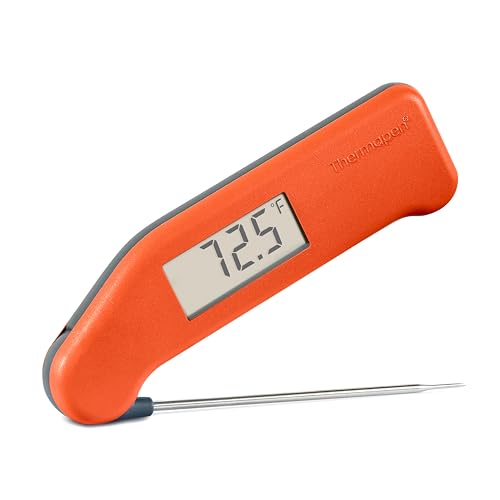
ThermoWorks Classic Thermapen Instant-Read Thermometer
$105.00The older Thermapen at a lower price, slower to read than the ONE but with the same probe accuracy, which is the part that matters for tempering.
Best for: accurate readings without the flagship price
Check price on AmazonAmazon prices move often, so check before you buy.
Questions people ask
- Why is the bake time for a 9 inch round, 2 in deep pan given as a range?
- Because a single number would be false precision. The figure here is computed from the pan geometry rather than measured, and on top of that home ovens commonly run 25 F away from their dial in either direction, which shifts a bake time by more than the whole range. Use 30 minutes as the moment to start checking and let the doneness test decide the rest.
- Should I bake this pan at 325 F or 350 F?
- 350 F is the convention for this pan, because its shortest span is under 10 inches at 2 inches deep, which is the range 350 F is meant for. Dropping 25 F always costs you time and always gives a flatter, paler cake, so it is a trade rather than an improvement.
- Do bake-even strips change the time?
- Yes, usually adding a few minutes, and they are worth it anyway. A damp strip around the pan slows the outside so the middle catches up, which is what stops a dome forming. The cake finishes flat enough to stack without levelling, so the extra minutes buy back the cake you would otherwise have cut off the top and binned.
Related pages
- Bake Time for a 9 inch round, 3 in deep Cake Pan
- Bake Time for a 9 inch heart, 2 in deep Cake Pan
- Bake Time for a 9 inch springform, 3 in deep Cake Pan
- Bake Time for a 8 inch square, 2 in deep Cake Pan
- Bake Time for a 9 inch square, 2 in deep Cake Pan
- Bake Time for a 8 inch springform, 3 in deep Cake Pan
How this page was put together
Researched from pan geometry, published manufacturer capacities, published serving conventions and university extension guidance. Not hands-on testing, and not professional advice.
Figures are labelled as derived, published or trade convention. Where no honest figure exists, the page says so rather than filling the gap.