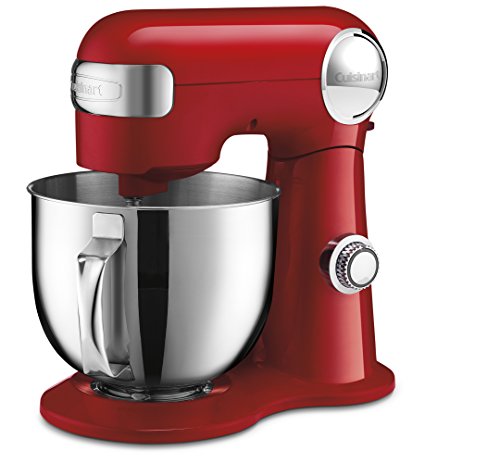
Which mixer bowl a batch actually fits, from published flour capacities rather than guesswork.
Quick answer
Two 12 inch round layers need about 20.9 cups of batter, which is past what a 5 quart bowl will take and wants a 7 quart at minimum. Published KitchenAid flour capacities run from 8 cups in a 4.5 quart bowl to 14 cups in a 7 quart.
The formula
usable batter (cups) = bowl quarts x 4 x 0.6
Manufacturers publish a flour capacity rather than a batter capacity, so this converts one to the other. The usable batter volume is roughly 60 percent of the nominal bowl volume, because a bowl filled past that cannot be mixed properly and leaves streaks of unincorporated flour around the wall.
Meringue work is tighter still. Egg white roughly doubles as it whips, so the bowl cannot be filled past about 40 percent at that stage, which is why a Swiss buttercream for a large cake often needs a bigger bowl than the batter did.
Derived, published or convention?
Bowl flour capacities are PUBLISHED KitchenAid figures. Converting those into a usable batter or meringue volume is TRADE CONVENTION, based on how much headroom a bowl needs to mix rather than on any published number.
What each bowl size will take
Bowl
Published flour (cups)
Usable batter (cups)
Egg white before whipping (cups)
Largest single cake it covers
4.5 quart tilt head
8
10.8
7.2
12 in round
5 quart tilt head
9
12
8
10 in round
6 quart bowl lift
12
14.4
9.6
14 in round
7 quart bowl lift
14
16.8
11.2
12 in round
8 quart commercial
16
19.2
12.8
16 in round
Flour capacities are published manufacturer figures; the batter and meringue conversions are trade convention.
Gear for these numbers
These are rendered from the verified catalog and re-ordered against your numbers once you calculate.
The default decorating mixer: 10 speeds down to a stir that folds rather than throws, a 5 quart bowl rated for 9 cups of flour, and the tilt head that makes scraping a buttercream bowl quick.
Best for:the buy-once home mixer for cakes and buttercream
A 5.5 quart bowl and 12 speeds at roughly half the price of the equivalent KitchenAid, with a chefs whisk and flat paddle included rather than sold separately.
Amazon prices move often, so check before you buy.
Questions people ask
Is a bigger mixer always better?
No, and a large bowl has a real drawback: a small quantity in a big bowl sits below the beater and never gets properly worked. A 7 quart bowl struggles with a single 6 inch layer for exactly that reason. Size the mixer to the largest thing you make regularly, not to the largest thing you might make once.
What does the published flour capacity actually mean?
It is the manufacturer figure for how many cups of flour the bowl can take in a bread or cookie dough, which is the densest thing most mixers handle. It is a useful comparative number across models, but it does not directly tell you a cake batter volume, which is why this calculator converts it rather than quoting it.
Can I mix a large cake in two batches?
Yes, and it is what a bakery does when a job exceeds the bowl. Make each batch to the same recipe and combine them by hand in a larger vessel before dividing between pans. The one thing to avoid is filling the bowl past its comfortable capacity, because that leaves streaks of unmixed flour that show as pale patches in the crumb.
Does a bowl lift mixer hold more than a tilt head?
Usually, because bowl lift models start at larger capacities, but the frame matters as much as the volume. A bowl lift holds the bowl rigidly from below, so it cannot rock on the hinge while a whisk runs at speed. That is why it is the preferred frame for meringue work even at similar capacities.
This calculator does arithmetic on the numbers you give it. It does not know your oven, your recipe or
your altitude. Figures are labelled as derived, published or trade convention, and where no honest
figure exists the calculator says so instead of producing one. Researched guidance, not professional advice.