Skip to content
CakeDecoratingCalc

Chocolate

Chocolate Tempering Temperature Calculator

Published melt, cool and working temperature ranges by chocolate type, with the seeding quantities.

Quick answer

Dark couverture melts to 115 to 120 F, cools to 82 to 84 F to set the right crystal, then comes back to 88 to 90 F to work. Milk and white run cooler at every step, because they carry less cocoa solid and more milk solid and sugar.

Result

Work at 88 to 90 F

Dark couverture: melt, cool to seed the crystal, then bring back up

Every figure, with what it is based on
FigureValueBasis
1. Melt to 115 to 120 F Melt 333 g, holding back 167 g as seed Published
2. Cool to 82 to 84 F Stir in the seed chocolate off the heat Published
3. Work at 88 to 90 F Warm gently back to this and hold it there Published
Seeding split 333 g melted, 167 g seed Trade convention

melt, cool to set the right crystal, then return to working temperature

These are published couverture manufacturer ranges. Makers print slightly different numbers for their own recipes, so the bag in front of you beats this chart. Compound coatings and candy melts are not couverture and do not need tempering at all.

The formula

melt, cool to set the crystal, then return to working temperature

The three step shape is the same for every type: melt fully, cool to seed the crystal you want, then bring back to working temperature and hold it there. Only the numbers move, and they move because the cocoa butter fraction differs.

The seeding method is the easiest at home: melt two thirds of your chocolate, then stir in the remaining third off the heat as seed. The unmelted chocolate carries the crystal structure you want and drags the whole batch into it as it cools.

Compound coatings and candy melts are not couverture and do not need tempering at all. They set hard because they are made with vegetable fat rather than cocoa butter, which is also why they never quite taste like chocolate.

Derived, published or convention?

These are PUBLISHED working ranges from couverture manufacturer charts. Makers print slightly different numbers for their own recipes, so the bag beats this chart. The two thirds seeding split is TRADE CONVENTION.

Tempering temperatures by chocolate type
ChocolateMelt to (F)Cool to (F)Work at (F)Why it differs
Dark couverture115 to 12082 to 8488 to 90Highest cocoa solid and cocoa butter content
Milk couverture110 to 11580 to 8286 to 88Milk solids and sugar in place of cocoa solids
White couverture105 to 11078 to 8084 to 86No cocoa solids at all, sets on cocoa butter alone
Published couverture manufacturer ranges. A degree or two matters here, which is why an accurate probe is not optional.

Gear for these numbers

These are rendered from the verified catalog and re-ordered against your numbers once you calculate.

Expert
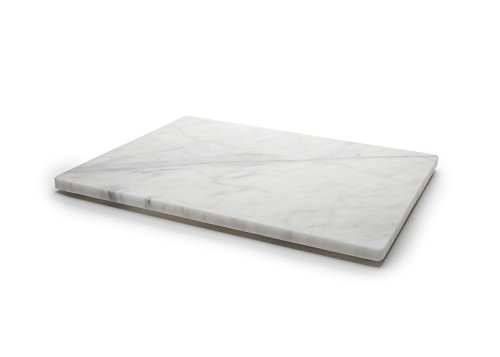
Fox Run Marble Pastry Board, 16 x 20 in
Fox Run

Fox Run Marble Pastry Board, 16 x 20 in

$70.39

Marble stays below room temperature, which is why it is the traditional surface for tempering chocolate by tabling and for rolling fondant without it going sticky.

Best for: tabling chocolate and rolling fondant

Check price on Amazon

Amazon prices move often, so check before you buy.

Questions people ask

What happens if chocolate is out of temper?
It sets dull and soft, often with pale streaks or a grey bloom on the surface, and it snaps limply rather than cleanly. None of that is a safety problem and it tastes the same. It is a crystal structure problem: cocoa butter can set in several forms and only one of them is glossy, firm and stable at room temperature.
Do I need a marble slab to temper chocolate?
No. Tabling on marble is the traditional method and it is fast, but the seeding method works with nothing more than a bowl and a thermometer: melt two thirds, stir in the remaining third off the heat, and let the unmelted chocolate carry the crystal. Marble helps most when you are working continuously and need to cool a batch quickly.
Why does white chocolate temper at a lower temperature?
Because it carries no cocoa solids and a high proportion of milk solids and sugar, both of which scorch more easily than cocoa does. Take white chocolate much above 110 F and the milk solids start to catch, which gives a grainy texture and a cooked note that no amount of stirring will remove.
Can I re-temper chocolate that has set badly?
Yes, and that is one of the useful things about chocolate: it can be melted and tempered again repeatedly without harm. Melt it fully back to the top of its range so every existing crystal is destroyed, then take it through the cool and working steps again. Chocolate that has bloomed is fine to re-melt.

Worked out for you already

A note on what this can and cannot tell you

This calculator does arithmetic on the numbers you give it. It does not know your oven, your recipe or your altitude. Figures are labelled as derived, published or trade convention, and where no honest figure exists the calculator says so instead of producing one. Researched guidance, not professional advice.